• about
  • books
  • contact & subscribe

GIULIA TORRE

~ reading and writing romance

GIULIA TORRE

Tag Archives: cover art

Review – The Mouth of Truth – Isobel Chace (1977)

27 Friday Mar 2026

Posted by Giulia Torre in captiviy, evil other woman, Harlequin Romance, learning to write, rich hero, Romance Cover Art, travel, tropes, vintage romance review

≈ Leave a comment

Tags

1970s harlequin, book-review, book-reviews, books, Boon Harlequin, category romance, cover art, fiction, Harlequin, romance, romance novel reviews, romance writing

Adiamo Roma!!

Alora, quindi, dai…
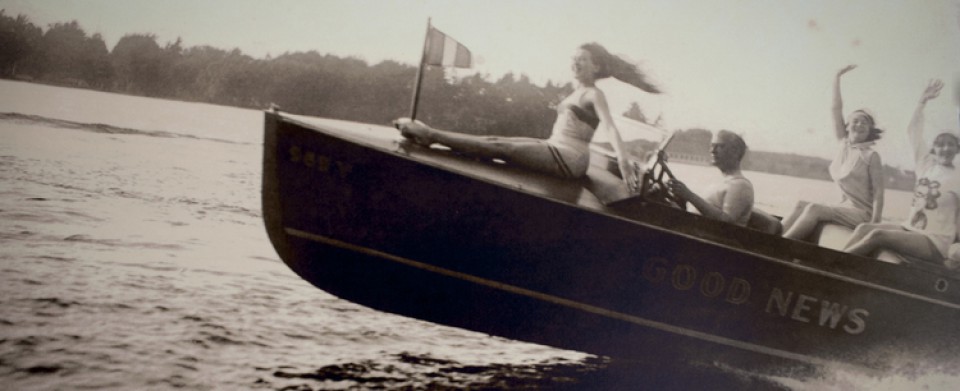
Required words for the truly Italian.

Also, kidnapping.

Isobel Chace had been writing for awhile by 1977 when this novel was published, with 26 Harlequins before this one.

Diving into the trope trove, Chace came up with captivity for The Mouth of Truth.

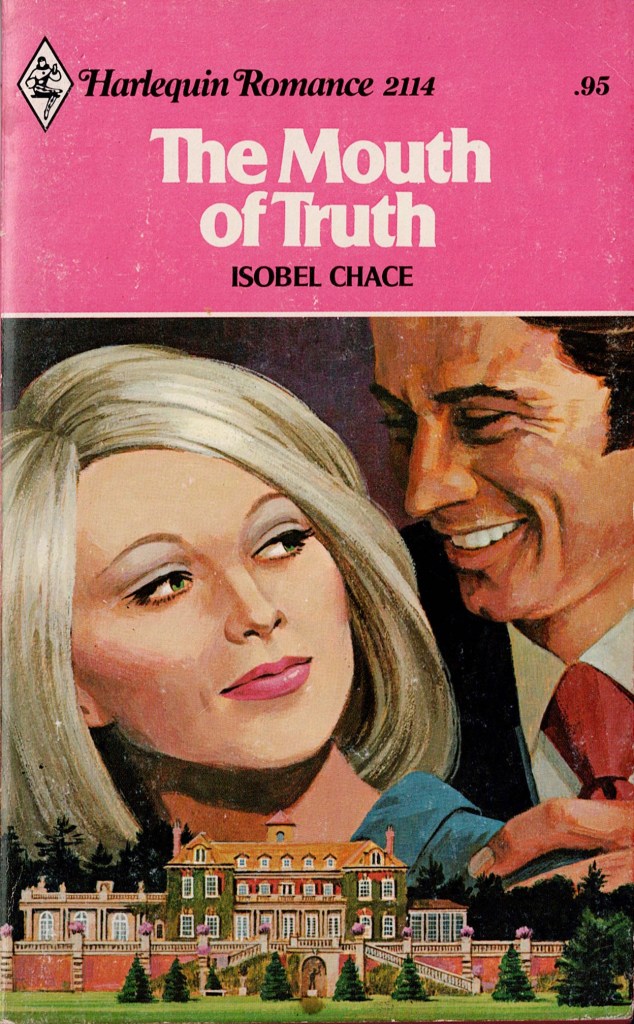
As the cover suggests, Domenico Manzù makes his pretty prisoner, Debbie Beaumont, comfortable.

First, with a new wardrobe a Corsa, “Rome’s equivalent to Bond Street.” OMG I can’t wait.

Debbie is an artist. She does a lot of “ultra modern stuff” as a sculptor and painter. She tells Domenico on her maiden limo ride minutes into her captivity: “It takes a while to break out of the chrysalis of needing someone else’s approval.”

Truer words, Debbie…

I wanted to read Isobel Chace (1934-2005) because she’s a career romance novelist. Goodreads shows 30 books, but I think there are more.

In spite of the yolk of reader expectation, Chace had likely broken out of her shell by The Mouth of Truth.
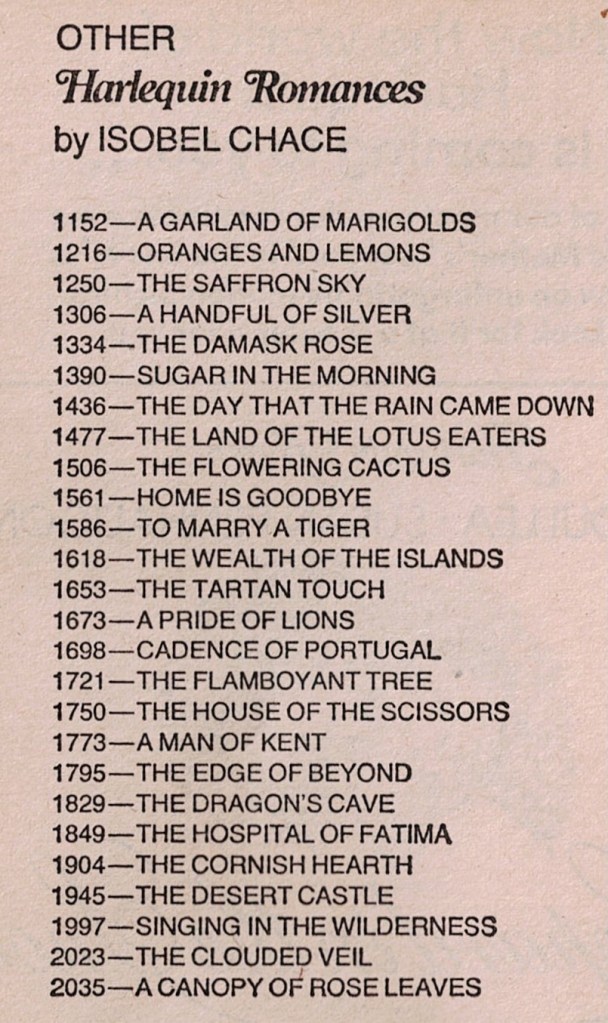
Goodreads (House of the Scissors) reports that Chace wrote under the pseudonym of Isobel Chace, and under her real names: Elizabeth Hunter and Elizabeth de Guise. Born in1934 in Nairobi, Kenya, she lived in in Kenya and South Africa, and studied at the Open University.

After 26 books, Chace is mastering the art of “swan lake in a phone booth” to quote romance author phenom and gajillionaire Nora Roberts about the category romance.

The Mouth of Truth had me at hello.

Chace opens with a father-daughter conflict, and with it, I was hooked. Let that be a lesson to you. It wasn’t perfect. It wasn’t terribly well-written. The prose wasn’t memorable, and the characters were a bit obtuse, but I got pulled along in spite of all the imperfections.

It’s all we need, dear author: a little conflict.

Deborah’s Dad is rich, absent (remarried with other kids), but still wants to protect his estranged daughter.

Debbie just wants to go to Rome with her friends. It’s on her own dime. Sure he’s paid her bills in the past! Is he going to begrudge her that now? (Exclamation point alert. Chace spares no spear.)

Deb’s Dad explains that his company had some business dealings in Italy recently and may have inadvertently thrown an election. It’s not ideal for someone sharing his name to visit Italy, not right now.

There’s some foot-stomping, some you-can’t-stop-me, and poof! Debbie is on the plane, staring out the window, wondering if she was right to come.

The plane ride to beyond is a recurring scene in this category line, where the heroines travel just about anywhere…as long as they’re under somebody’s thumb from tarmac through touchdown.

Do you suppose I like being kidnapped?

Thus, the need for this contrived and silly trope.

It’s a hard pill to swallow now, this plot template, but consider the plight of woman in 1977.

The world has shifted beneath the words on these pages, so it’s only fair to take them for what they were worth fifty years ago, recalculating for inflation.

In spite of the fact that this category line resorted to kidnapping, captivity, and a continuum of lock-her-in-a-room scenarios, the machination allowed women to travel the world, essentially on their own.

I’ve said it before, and I’ll say it again, romance is a feminist enterprise.

‘That is one of the advantages of being a man, signorina. My family, like yours, would undoubtedly be far more shocked at your allowing me to kiss you than by my doing so. It’s the way of the world!’
She opened her eyes wide. ‘You mean they’d blame me?’

And gosh, if we compare women’s rights 50 years ago to what we have now, a few elements of 1977 look pretty good.

Anyhoo.

Adesso…Roma!

Enjoy old-school historical romance? Me too! Start with Wolfe Island. It’s available in paperback, ebook, and Audible.

Sign up for more vintage romance reviews. Subscribe to Giulia’s newsletter! I read and write romance and could talk about either, all day long.
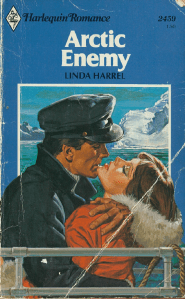
Review – Arctic Enemy – Linda Harrel (1981)

01 Thursday Oct 2015

Posted by Giulia Torre in Uncategorized

≈ Leave a comment

Tags

1970s harlequin, 1980s harlequin, Boon Harlequin, category romance, contemporary romance, cover art, Mills and Boon, romance novel reviews, romance reviews, romance writing

Arctic EnemyArctic Enemy Harrel romance cover art by Linda Harrel (1981) puts journalist Sarah Grey on supertanker Arctic Enterprise during its the maiden voyage through the Northwest Passage, and earns my esteem by spelling ‘grey’ the right way.

The trip is perilous indeed. The Enterprise is designed to load up on liquid gas then nose its way through the ice of the ocean with its highly combustible cargo. Unfortunately, the book’s anti-hero has built the Enterprise with substandard materials, something breaks in the middle of the ocean, and our true hero – Captain Guy Court – must save the day. Which he does. But not before he and Sarah snowmobile out into the arctic countryside, get caught in a storm, and almost make love in an igloo.

It’s a standard hate-at-first-sight / he-thinks-she’s-sleeping-with-the-bad-guy plot line, seasoned with interesting arctic trivia. Did you know that icebergs “calf”?

But enough about global warming.

I’m developing book three of my Diamonds on the Water series, titled The Hard Dock. Yes, I’m really going to title a historical romance that I actually hope to sell The Hard Dock. Because docking can be hard, as anyone who’s ever tried it knows.

The Hard Dock‘s hero – Michael Low – is captain of a tugboat. The heroine – Dorrie Tremont – is a stowaway who gets herself into more trouble than Mick can manage alone. Together, they make a great team. In spite of his angry-man reserve and her counter-phobic pluck.

An actual hard dock is my preferred corner of the Thousand Island Region of Upstate NY, where this series is set in 1893. It’s a concrete dock in a busy spot of the river channel, from where I can swim, watch large freighters pass, and spy on hard-bodied youth as they hurl themselves, heads foaming with shampoo, from the adjacent wooden pavilion dock. The hard dock is less populated, more to my liking.

The point of this summer-nostalgic mawk is that I selected Arctic Enemy because I thought it would be valuable research for The Hard Dock.

Anyone who’s ever written a romance knows there’s no better introduction to scientific and historical fact than another romance author.

Alas, the sexiest moment in Arctic Enemy is when Harrel somehow channels Jean-Luc Picard six years before Next Generation launches its version of the Enterprise.

‘Come!’

I wish.

Enjoy old-school historical romance? Me too! Start with Wolfe Island. It’s available in paperback, ebook, and Audible.

Sign up for more vintage romance reviews. Subscribe to Giulia’s newsletter! I read and write romance and could talk about either, all day long.
Review – The Little Nobody – Violet Winspear (1972)

15 Monday Jun 2015

Posted by Giulia Torre in Giulia Torre, Harlequin Presents, Harlequin Romance, Hero Archetypes, Romance Cover Art, Uncategorized, vintage romance review, Violet Winspear

≈ 2 Comments

Tags

1970s harlequin, Boon Harlequin, category romance, contemporary romance, cover art, harlequin presents, harlequin romance, Mills and Boon, retro romance, romance novel reviews, vintage romance reviews, Violet Winspear

A Romance Canon, one as staid and firm (and stout) as Harold Bloom‘s should include Violet Winspear, whose corpus includes over 90 titles written for Mills & Boon. I love her name almost as much as I love Foyle’s War’s Honeysuckle Weeks.

The Little Nobody was chosen for the alpha hero lurking beyond it’s title.

Violet Winspear The Little Nobody

With a little nobody, a Big Somebody must be in there somewhere.

Violet Winspear is known for (notorious for at one time) her alpha heroes: angry, incomprehensible heroes and our future bodice rippers. In 1970, she explained:

I get my heroes so that they’re lean and hard muscled and mocking and sardonic and tough and tigerish and single, of course. Oh and they’ve got to be rich and then I make it that they’re only cynical and smooth on the surface. But underneath they’re well, you know, sort of lost and lonely. In need of love but, when roused, capable of breathtaking passion and potency. Most of my heroes, well all of them really, are like that. They frighten but fascinate. They must be the sort of men who are capable of rape: men it’s dangerous to be alone in the room with.

The category line Winspear helped to launched has pervasive arm-gripping, angry kissing, and even spanking. Still, she got a little flack for that.

The Little Nobody is only #15 in the original Harlequin Presents line (of thousands). A more recent Harlequin line of the same name has the same mission as the original:

You want alpha males, decadent glamour and jet-set lifestyles. Step into the sensational, sophisticated world of Harlequin Presents, where sinfully tempting heroes ignite a fierce and wickedly irresistible passion!

The little nobody is Ynis Raiford. She is newly arrived on a dark and stormy night to a gothic castle on the Cornish Cliffs (Cornwall, England) called the Sea Witch.

Her name – Raiford – is not even hers. It’s borrowed from her stepfather, a con man serving time as a result of his designs on the hero’s fortune (a part of it at least). The hero – Gard St. Clair – is a former maestro whose arm was injured by a freak storefront accident, and then severed from his body at the shoulder by a surgeon, unaware he was operating on a famous conductor because Gard’s wallet had been stolen from him by a pickpocket while he was still unconscious and bloody beneath the shattered pane of glass. So, when Ynis’ petty thief stepfather was caught trying to steal from Gard a couple years later, our hero was still a little touchy and unforgiving. Ynis ventures to the Sea Witch to persuade maestro Gard to drop the charges, but finds the hero a tad embittered by pickpockets, his missing arm, and, presumably, the bad weather.

The bad weather is important, because after Gard declines Ynis’ request to free from prison the only family she’s ever known, she runs out into the dark, stormy night and is deservedly hit by a car. She awakes back at the Sea Witch with amnesia and a ring on her finger. Gard claims she’s his fiancé.

Readers of this line are given no insight into the thoughts and feelings of heroes beyond their actions and smoldering looks of incomprehensible rage, but we can assume the hero feels guilty, or something.

So there we have it. Add another woman – “his old love, the beautiful actress Stella Marrick” – and the set-up is a typical 1970s Mills & Boon pretzel-plot.

Of significance…Ynis has been living in a convent for the better part of her life. Though the Reverend Mother tried to convince Ynis to take orders, instead Ynis wants to see the world. She’s at her hills-are-alive moment when this book begins.

What the heroine’s convent background provides is a nice dose of virgin envy. Yes, it’s a real thing. And Winspear knows how to work it.

He didn’t care a rap she found him more fearful than fascinating. He seemed to her to enjoy the fear which she felt. ‘There are certain terrors known only to a girl,’ he said. ‘The fact is fascinating to a man, and that’s the bare truth.’

Virgin envy. I’m green with it.

REVIEW – Dangerous Marriage – Mary Wibberley (1980)

22 Saturday Nov 2014

Posted by Giulia Torre in Harlequin Romance, Romance Cover Art

≈ Leave a comment

Tags

1980s harlequin, 1980s romance, Boon Harlequin, category romance, contemporary romance, cover art, giulia torre, Harlequin, harlequin romance

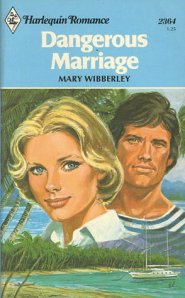
Dangerous Marriage by Mary Wibberley (1980)

Dangerous Marriage coverHarlequin Romance #2364

I’m not all about the sex. I’m not. Don’t believe me?

I’m reading The Romance Revolution: Erotic Novels for Women and the Quest for a New Sexual Identity by Carol Thurston (1987).

Reading The Romance Revolution, it occurs to me just how smart women had to be in the academy in the 80s to be taken seriously. This book is rich with research and insight. Each chapter is a book unto itself by today’s standards.

My favorite analysis of popular romance, until now, was Janice Radway’s Reading the Romance. But I prefer Thurston’s methodology. Both Radway and Thurston explore readers’ responses to romance, but Thurston’s methods include a comprehensive analysis of plot and character, the texts themselves. Where Radway’s work is an ethnography, Thurston’s is a discourse analysis, one that takes the reader beyond the often self-referential textual analysis of New Criticism.

I suppose I should be grateful that at my age, I’m still thrilled by academic discovery. But this discovery would have been more helpful when I was a critic. Not just scanning for sex scenes…

So back to that.

Thurston in her opening chapter “The Romance Novel as Popular Culture” outlines her erotic romance data set. The Harlequin Romance line, of which I have been reviewing in my last posts, is not included. That’s what I’ve been saying about this line. No sex.

Thurston reports that, “With a few notable exceptions…the character of male-female relationships portrayed in [this] line remains…the incomprehensible/cruel hero and the insecure/masochistic heroine”.

That’s it. Utterly incomprehensible. I’m relieved to know it’s not just me.

It’s not just the frustrating absence of erotica that excludes this collection of books from Thurston’s analysis. She reports that critics of popular romance as a rule disregard these “classic” romances and cites a Romantic Times (1985) writer: “One wonders when Harlequin will realize that this is not romance at all.”

I can’t agree or disagree. Romance is too subjective a notion to disregard anything outright as not romance. Instead, I’ll argue it either scratches your itch, or it doesn’t.

Take Vargen Gilev.

Yes, ladies. Vargen Gilev. It bears repeating.

Vargen is the “handsome island entrepreneur” who is Mary Wibberley’s incomprehensible hero in Dangerous Marriage. He is a “hard-eyed, hard-faced stranger,” alpha all the way. In spite of the Marimekko shirt he’s wearing on the cover.

The heroine, Shelley, has arrived on Avala to buy a hotel. Her domineering father has demanded that she do so. Vargen also wants the hotel – has actually already purchased it – but more than that, he requires the respectability a marriage will give him. He persuades Shelley to marry him.

Hey, wait. We have a marriage plot. Chin up. There might be sex because they’re married.

Shelley could have been a vindicated heroine, the trope described in Kiss of a Tyrant. But the reader is offered no feeling of vindication. Although Vargen is incomprehensible, he is not cruel.

True, he consummates their marriage while she’s still groggy from the Russian vodka he’s made her throw up fifteen minutes before. But the author Wibberley has more cruelty than Vargen. Vargen by my account is a hottie, and I’ve been duly revved. But their consummation is oblique.

She felt the hard bed beneath her and was aware of having been lifted and placed there, and she lifted her arms to him, to pull him down to her, to hold him as she had never held anyone before…There was only darkness, and movement, and two bodies that became as one…

Only darkness? Only movement? What about his penis?

The plot’s twists are a righteous yoga pose designed to explain the hero’s actions for the previous 180 pages. It’ll just confuse us both if I try to recap.

Shelly, after a lifetime of emotional and psychological abuse by her father, is skittish. When Vargen grabs her to keep her from falling over the balcony, she rages. The typical fist flailing against his hard, broad chest. Shelley almost falls off two balconies, cuts her foot, nearly drowns, suffers alcohol poisoning, and is kidnapped.

Through it all, Vargen is impassive, hard. Incomprehensible.

Until the final scene, when he rescues her from her kidnappers and melts.

 ‘I love you Shelley, I love you very much…,’ he groaned. ‘Oh, my dearest…’

And more like that. Some darlings. Some my loves. I prefer my reserved heroes to remain reserved. His softening at the end of a book feels like a betrayal. He can love her but still look mean. That’s the point.

I’m so done with this line. Where the hell is Avala anyway?

Up next…Harlequin Temptations. I remember stealing these from my mother and hiding them under my bed. They’re included in Thurston’s analysis of erotic romance, and a box has just arrived on my front porch – an accidental pregnancy after a few tipsy minutes on Ebay.

Yeehaw.

REVIEW – Kiss of a Tyrant – Margaret Pargeter (1980)

29 Wednesday Oct 2014

Posted by Giulia Torre in Harlequin Romance, Hero Archetypes, Romance Cover Art

≈ 1 Comment

Tags

1970s harlequin, 1980s harlequin, 1980s romance, best romance novels, Boon Harlequin, category romance, contemporary romance, cover art, giulia torre, Harlequin, hero, hero archetype, retro romance, retro romance novels, romance book review, romance cover art, romance novel cover art, romance novel reviews, romance reviews, romance writing, romantic hero, vintage romance

Kiss of a Tyrant PargeterKiss of a Tyrant by Margaret Pargeter
Harlequin Romance #2375

The virgin’s vindication. One of my favorite tropes. If you don’t know of it yet, it’s a good one. It culminates with the hero – an angry man of the highest order – as his head snaps up to look in mute horror to study the face of the maiden beneath him after he’s inadvertently stolen her virginity. The inadvertent part is important.

But not as important as the hero’s grim belief that the heroine is not a virgin. And dammit, she should be.

What if I asked you to prove you’d never belonged to another man?

Such is the way with Kiss of a Tyrant.

Sloan Maddison is an Australian alpha male who finds himself in the English countryside where his widowed mother contemplates returning to live. In a country inn, he meets interior decorator Stacy Weldon. Stacy is “on leave” from her career, helping her mother and sister at the inn after being nearly raped by her boss. She is wounded and angry and not optimistic about her future.

Sloan is attracted to her. Pretty sure he wants to marry her. So uses his mother’s illness as an excuse to carry her off to Australia. But on the way out the door, he gets wind of that “affair” with her boss. And he’s hopping mad about it. She must have asked for it, and along the way, collected other affairs that now debases their own kindling desire.

The hero’s she-must-have-asked-for-it motivation is a hole in the plot that has widened over time. But it’s easy to jump across. Because Sloan is sexy in the way only an angry pants hero can be. Mean, misguided, and hard to get. Oh, but in love nonetheless.

The wrap-up is a bit holey, too, and would have been for readers even in 1980. Sloan is mean to Stacy up until the final moment, but claims he had known of her innocence for the preceding two whole days before the final page. He wanted to see if she could really adapt to his remote Australian way of life. Huh.

Sloan is mean as a billy goat. But, alas, sexier. So I can forgive the holes, even if Mr. Angrypants can’t.

REVIEW – The Angry Man by Joyce Dingwell (1979)

22 Wednesday Oct 2014

Posted by Giulia Torre in Harlequin Romance, Hero Archetypes, Romance Cover Art

≈ 1 Comment

Tags

1970s harlequin, Boon Harlequin, category romance, contemporary romance, cover art, giulia torre, Harlequin, hero, hero archetype, retro romance, romance book review, romance cover art, romance novel cover art, romance novel reviews, romance reviews, romance writing, romantic hero, vintage romance, wolfe island

The Angry Man Joyce DingwellThe Angry Man by Joyce Dingwell (1979) Harlequin Romance #2318 The Angry Man. How could I not?

First, a detour to cover art. I am working with an artist on the cover of book two of the RiverLust series, Simon’s Story. It’s called Swan Bay. I don’t believe you can paint a handsome man on the cover of a romance novel. Beautiful heroines? Yes. But the heroes always come off wrong.

Point in fact: The Angry Man cover hero is bleak. Crocodile Dundee with a longer face and shadowed, sunken cheeks. His hair is some kind of a poofy gray 70s mullet. Go ahead. Take a look at the cover of The Angry Man. Does he look angry to you? See that slight lift of his upper lip, over there on the right? The way his brows are furrowed together as he regards the heroine? Yes. The lovely doe-eyed one.

He is not angry; he’s sardonic, bemused. The man on this cover looks more perturbed than angry. Which is the perfect summation of Joyce Dingwell’s hero in this book.

English Polly loved her neighbor, who loved her sister, so her uncle sent her away. To Australia. Where after working on a statistics team as the resident non-statisician, she is told she has to stay another six months, because her former lover’s courtship of her sister is going more slowly than anticipated. So she takes the position of paid companion to Mrs. Clemance, young and beautiful wife of Thorn Clemance. Thorn is an ag specialist for a pharmaceutical company. A medical herbalist. But the beautiful Mrs. Clemance is not his wife. It’s his cousin’s widow. The hero is, in fact, not married. We learn this as the heroine does, and it’s a breathless beat.

Look at me, MissKendall, look at me, tell me what you see.’ ‘I-I don’t understand you.’ Polly tried to retreat a step, but he advanced, and at once they stood barely an inch apart. I think you do understand. I think you see a man who is a no-half-measures man. I think you see a man who would not be put off with subtleties, evasions and half-truths from any woman he made his wife. I think you see a man who would demand an entirety, a fulfillment, a conclusion, a completion.’ A pause. ‘I think you see a man who would be demanding four, not eight walls.”

Oh, dear. Here’s looking at you.

The ultimate logic of conflict? Unknown.

There is an ancestral puzzle requiring a flow chart to comprehend. And, for some reason, Thorn couldn’t tell Polly about his cousin’s widow’s recent sanitarium visit, her convalescence in his home, or the will that required that before she inherit, she must remain unmarried for two years. Which would have explained Polly’s charge to keep the young woman away from men.

The hero is in fact exactly like his picture (and the reader). Confused and frustrated. Not an awful book. Joyce Dingwell (b. 1908) wrote 80 of them. She knew how to write.

But for this one, in the end, I am left with only a single, bright nugget: Upon first introduction, her toes were dipped in the river until he found her and hauled her out. A shark had taken the hero’s dog from that very rock, only a week earlier.

There is no cure for a shark attack…When you put your gear on we’ll get back.’ ‘Gear? I’ve only removed my shoes and my pantyhose!’ He shrugged, saying almost uninterestingly: ‘Put ‘em on.’ Incensed, feeling a fool, hoping at least he would look away as she did so, Polly complied. It was not easy to wriggle discreetly into pantyhose, and she wished he would wander off. A tactful man would have. But he didn’t, he stood there right to the final hitch.

The final hitch? This whole line of books is worth reading for the settings. These girls get to go everywhere.

SWAN BAY cover sketch – Book Two

17 Friday Oct 2014

Posted by Giulia Torre in Romance Cover Art

≈ 1 Comment

Tags

best historical romance, cover art, giulia torre, swan bay, thousand islands, wolfe island

Working again with Tracy Hetzel of Long Blue Straw on the cover for the Wolfe Island follow up, Swan Bay. Again, set in the thousand islands of upstate NY in 1893. Though historically ‘accurate,’ the setting is fictionalized representation of Thousand Island Park and the surrounding region.

This is Simon’s story.Swan Bay sketch Giulia Torre Longbluestraw

For text and image teasers, visit my Wolfe Island Pinterest Board.

My husband proposes that this be called the RIVERLUST series. Which is funny. So may just stick.

REVIEW – Fool’s Paradise – Ann Cooper

25 Thursday Sep 2014

Posted by Giulia Torre in Uncategorized

≈ 1 Comment

Tags

1970s harlequin, 1980s harlequin, 1980s romance, best romance novels, Boon Harlequin, category romance, contemporary romance, cover art, harlequin romance, romance book review, romance novel reviews, vintage romance

Fool’s Paradise by Ann CooperFoolsParadise
Harlequin Romance #2383 (1980)

Recently a girlfriend told me about a neighbor’s bachelor party she surveilled while crouched in the yard beneath a window. One stripper. A dozen men. Wouldn’t you know it? Two hours later she was watching these friends fight in the street.

It’s an age-old formula: sexual tension minus sexual release equals…

For one incredible moment she thought he was going to beat her.

Girls in these romances knew how to keep it close and tight. As a result, Fool’s Paradise features another angry-pants alpha male. I love a Mr. Angrypants when he’s dropped in an HEA…So long as he doesn’t leave me with a case of blue-box, which I’m realizing this era of Harlequin breeds in spades.

Meet-up: He’s the distant family relation (and former lover) newly appointed to save from bankruptcy her historic heirloom home. (cf. The Grass is Always Greener with Debra Kerr, Cary Grant and Robert Mitchum c. 1960).

Conflict: He is angry because she ran away when he proposed marriage. She loved him, but he’s city refined and she’s country estate, so she thought he was proposing marriage to get into her panties. Which would have been my preference.

Although some highly-prized petting does occur off-scene:

He kissed her toes – no one had ever kissed her toes before – then he kissed her knees and finally, a long time afterwards, he was kissing the tips of her fingers. There wasn’t anywhere at all left undiscovered.

Nowhere? Nowhere at all?

In the end, their consummation had me chucking the book onto the nightstand:

It was a long time later when Emma finally woke up in Nicholas’ bedroom.

Am I angry? Not really. It was a good, fast read. And a house full of blue-boxed women won’t result in fighting in the streets.

REVIEW – Rough Justice – and Hero Archetype #2…Mr. Angrypants

20 Saturday Sep 2014

Posted by Giulia Torre in inexorable slide, Lisa Kelypas

≈ 2 Comments

Tags

#sexysentences, 1970s harlequin, 1980s harlequin, Boon Harlequin, category romance, cover art, giulia torre, Harlequin, hero, hero archetype

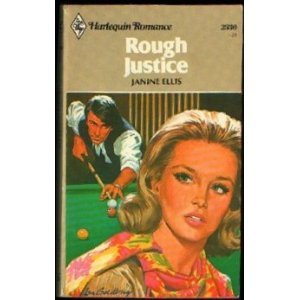
rough justiceRough Justice – by Janine Ellis. Harlequin Romance #2330 (1979)

It’s difficult to describe the disappointment of effective sexual tension that does not end in consummation. Oh wait. I know how. Harlequin has blue-balled millions of readers (and heroes).

No penetration station for these Harlequin Romances. None of Kleypas’ inexorable slides. A euphemism would have been fine. But there is even none of that.

Many of the back cover plot summaries promise women marrying men they hate, don’t know, are scared of, or are otherwise duped by. Perhaps when I hit one with a post-marriage plot, I’ll get my consommé. In the mean time, I am stuck with hauntingly unfulfilled. I am haunted, because this is really quite a well-written book.

The heroine is not stupid. She’s accepted the position of chambermaid at a rich friend’s hotel in Cornwall, England, where from 7am to 1pm she cleans rooms, (including the hero’s), but after work, she’s like one of the family – feuds and all.

As is typical with this decade, multiple actors people the set. The hero has his pick of three other women, total. The heroine, two men.

The title – Rough Justice – describes the hero. Lots of bruised wrists and lips, and jaw muscle clenching, twitching, and jumping. My favorite type of hero, Mr. Angrypants, who gentles when the temperature is right.

He hauled her to her feet, and for a moment she thought he was going to hit her. His hand found her throat and he forced her chin up so that she met his eyes. She had never seen such naked anger, and when he spoke he seemed to have difficulty keeping himself under control. ‘You won’t marry Graham, Lorraine,’ he bit out. ‘I don’t care what I have to do to prevent it…The sooner you give in to me, the better it will be for both of us. The longer you resist me, the worse I’ll make it for you.

Ahh. Make it worse. Please.

Mr. Angrypants is a sub-type of Hero Archetype #1, Mr. Reserve. Mr. Reserve may be trying not to do any number of things while he tries not to kiss you. Mr. Angrypants is simply trying not to rape you. The final scene of Rough Justice illustrates this, where you would think perhaps now that they’ve agreed to marry, you might get some:

‘Do you surrender?,’ he asked, and she nodded, stilling underneath him, and breathing rather shallowly as she felt his full weight against her…After a while, Mark lifted his head and gazed down at her with a warmth that made her shiver…’Tempting as you are, my darling, I’m still angry enough to hurt you – and, he added softly, ‘you know I don’t want to do that.’

Do it. Do it do it do it do it.

His 70s fashion standouts – a navy blue velvet suit, which he wears whenever they play dress-up. The other men wear black velvet suits, so I am assuming navy is somehow innovatory (sic). Innovatory is a word actually used in this book. I feel silly that I haven’t been using it myself.

Her 70s fashion. Simply awesome. I wanted every outfit she wore. Lots of gauzy white cotton dresses and leather sandals. Tight Tshirts and blue jeans. A navy blue and white striped shirt that she finished off with a ‘jaunty’ red kerchief around her neck, because she wanted to look ‘young, fresh and vulnerable.’ This heroine makes fashion choices.

I loved this book! As pitched on the back cover…She’d always wanted to meet Mark Taylor.

Me too.

The Golden Touch (Second Chance at Love, No. 58) by Laura London, Robin James

18 Thursday Sep 2014

Posted by Giulia Torre in Laura London

≈ Leave a comment

Tags

#sexysentences, 1980s harlequin, best romance novels, contemporary romance, cover art, robin james, romance book review, romance novel reviews, Second Chance At Love, sharon and tom curtis, Windflower

The Golden Touch (Second Chance at Love, No. 58)The Golden Touch by Laura London

The meetup: Superstar hero walks into local instrument shop to have his guitar peg fixed by small town heroine.

The conflict: He’s a superstar; she’s smalltown. She’s also a widow, which throws a wrench in the gears, but really it’s the bigtime vs smalltown.

80s fashion: This book was published in 1982, so really it’s still 70s fashion. He wears lots of leather pants. Doeskin for him anyone?

The Penetration Station: Get a load of this one!! I am including the text even after ellipses, as grammar manuals agree that an ellipses at the end of a sentence would include four dots, and RJ included only three….

And then the pinpointed, specific attentions of his fingertips ceased, and he placed his two broad hands on her bare hips, holding her up to him, and she waited in a rapt and aching anguish before she felt a low, warm sliding, and the waving tips of the clover and the brilliant blue sky seemed far away, and yet lent themselves to an unimaginable clarity as she dug her fingernails into the small of his back and moaned…His mouth simultaneously invaded hers, to no resistance, fierce, hungry kisses, random and love-violent, different from the gentle rhythmic movement of his hips as he lifted her, his hand under her shoulders, her blond hair spilling around them over the clover as he searched for, found, and held her most profound and silken depths, covering her face and mouth in fiercely loving kisses, murmuring love words (p. 113).

Ladies, we have a winner. The longest penetration sentence ever.

Survey Says: I read this book because of The Windflower. I’m moving through all of this couple’s books (Tom & Sharon Curtis). Where are they now? I prefer to leave it a mystery. In the mean time, I am enjoying their books. The Golden Touch was published immediately before Lightning that Lingers, which preceded in publication The Windflower.

As when reading Lisa Kleypas, the later books developed a level of expertise that only practice can make perfect. Earlier books can be lackluster, especially in comparison. This book is an example. The hero and heroine both lack a certain like-abilty, even credibility. But the story is still one I kept picking up, wanting to see how it ended. I gave it four stars because if you like Laura London, this is a why-not read. Doesn’t seem like they’ll be writing any more….

My rating: 4 of 5 stars

View all my reviews

← Older posts

Giulia Torre on Facebook

Giulia Torre on Facebook

Pages

  • about
  • books
  • contact & subscribe

Archives

  • March 2026
  • December 2025
  • September 2025
  • August 2025
  • August 2024
  • December 2017
  • November 2017
  • October 2017
  • September 2016
  • December 2015
  • October 2015
  • June 2015
  • May 2015
  • February 2015
  • January 2015
  • November 2014
  • October 2014
  • September 2014
  • August 2014

Enter your email address to follow this blog and receive notifications of new posts by email.

Goodreads

Blog at WordPress.com.

  • Subscribe Subscribed
    • GIULIA TORRE
    • Already have a WordPress.com account? Log in now.
    • GIULIA TORRE
    • Subscribe Subscribed
    • Sign up
    • Log in
    • Report this content
    • View site in Reader
    • Manage subscriptions
    • Collapse this bar
 

Loading Comments...