• about
  • books
  • contact & subscribe

GIULIA TORRE

~ reading and writing romance

GIULIA TORRE

Tag Archives: books

Review – The Enchanted Trap by Kate Starr (1963)

23 Tuesday Jun 2026

Posted by Giulia Torre in Harlequin Romance, Romance Cover Art, tropes, vintage romance review

≈ Leave a comment

Tags

1970s harlequin, book-review, book-reviews, books, Boon Harlequin, category romance, cover art, fiction, Harlequin, romance, romance novel reviews, romance reviews, romance writing, vintage romance reviews

Iconic Mills and Boon mid-century trope: Man’s literal job is to destroy the only thing the girl holds most dear, usually a house. Sometimes a hotel or other hospitality institution, like an orphanage. 
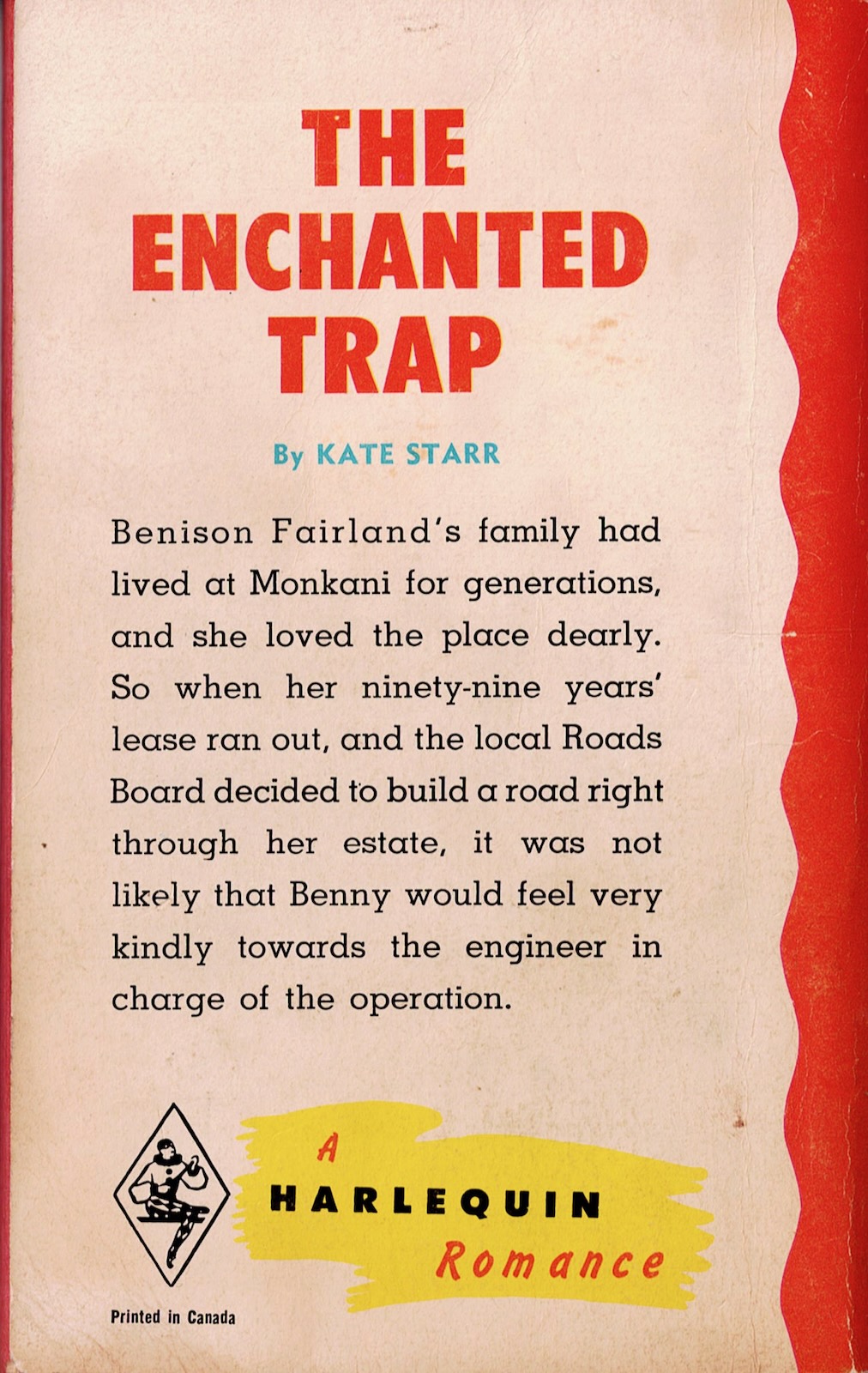
the enchanted trap Harlequin by Kate Starr 1963 edition

In the case of the Enchanted Trap, it’s both – a hotel for children whose parents are going abroad for a month or so. 

 A kennel for children. 

The house is called Monkani and it sits on a parcel of land needed for a road. Why the road has to go right through the house and not around it is unclear. 

Monkani means ‘many thanks’ in the aboriginal language of the Australians who lived there when the house went up 120 years before, when the land was granted to ther heroine’s great-great grandfather by the government in thanks for the discovery of silver. Many thanks!

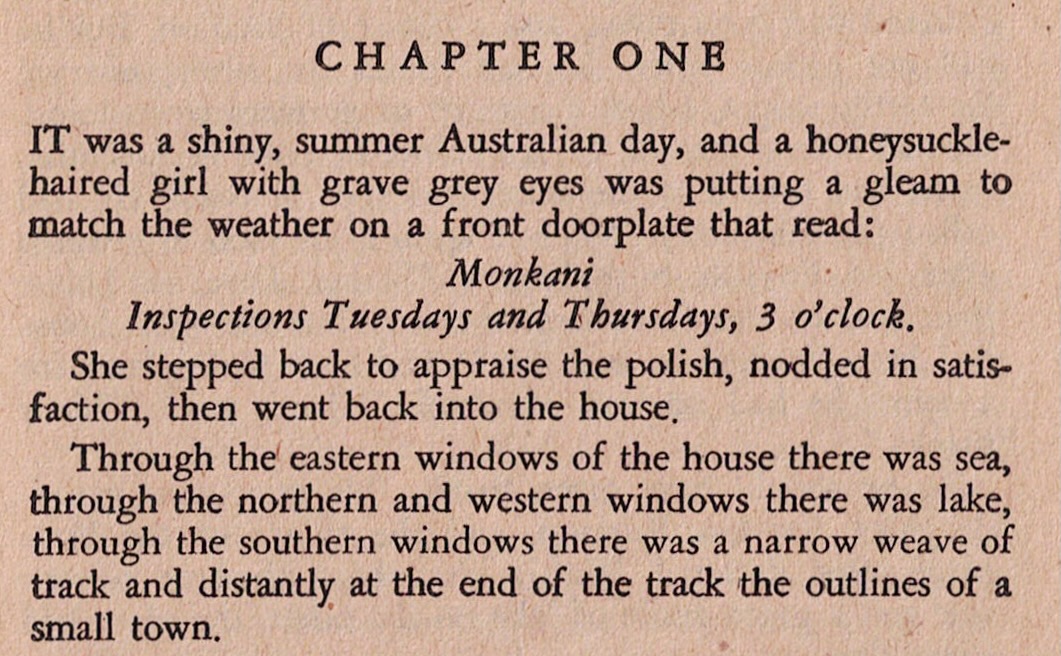
Kathy Starr’s prose is terribly good.

Listen to this intro.
the enchanted trap Harlequin by Kate Starr 1963 edition

But the man is Not Nice.

Yes, he has a way with the children staying at the hotel, so the reader is meant to recognize a tender heart beneath, but he uses his physicality to brow beat and disarrange the heroine. 

I don’t like it when a man squeezes a woman’s shoulder until it hurts to make her do something she doesn’t want to do or picks her up bodily to take her somewhere she doesn’t want to go. Especially in real life, and not in a romance novel. 

But I kept reading because the heroine is strong in more interesting ways than muscle. 

Benison “Benny” Fairland decides to charm Dominic Boyd the road builder and make him believe through repeated bouts of subtle interest cunningly withdrawn that she is submitting to his bulldozer. 

There is very often a moment in these old texts where the author has the hero say something that doesn’t time-travel well, like this:

For a moment you forgot and followed your heart and not your mind…Admit it, now. Admit, too, Benison Fairland, that deep, deep down you’re not really resenting all of this as you’re so obviously trying to. That, like the rest of your sex, you fundamentally prefer to be regulated and controlled.”
This time she could not plan any answer, she simply had to burst out. “You — you—“ she flung, as red in the face as the red handkerchief round the neck of the man in the electric drill. 
“All women like authority,” he said kindly. He lit a cigarette. “Don’t explode,” he advised her. “I like you nice and intact as you are, not disintegrated. I’ve enough disintegration on my road.

A lot to unpack. At least he doesn’t want her ground up. 

This exchange is followed by another moment when he picks her up and for the second time in the book’s first act carries her against her wishes. 

So.

What is the reader supposed to make of Benny’s impotence in the face of Dom’s authority?

Really hard to say.

Am I supposed to feel the feminist in her inarticulate rage? And/or should I find Dom’s appeals to her heartfelt desire to be controlled exciting. At this point in the book, I have no idea. 

Kate Starr, the author has made the heroine impotent in so many ways that I wonder if Benny can only come out on top in the end. Otherwise, what’s her trajectory? Could it be that she starts out a “fish-spinster” resisting the patriarchy, and turns into a submissive guppy?

Alas, it ends with a ritualistic finale for this era’s romance: the heroine wins, but only by getting the chance to destroy the thing she holds most dear by her own hands, a sacrifice for the evidence bag of love. 

And in 1963, no sex. Not even as awesome make out session.

I read it all the way through, but in the end two thumbs down. 
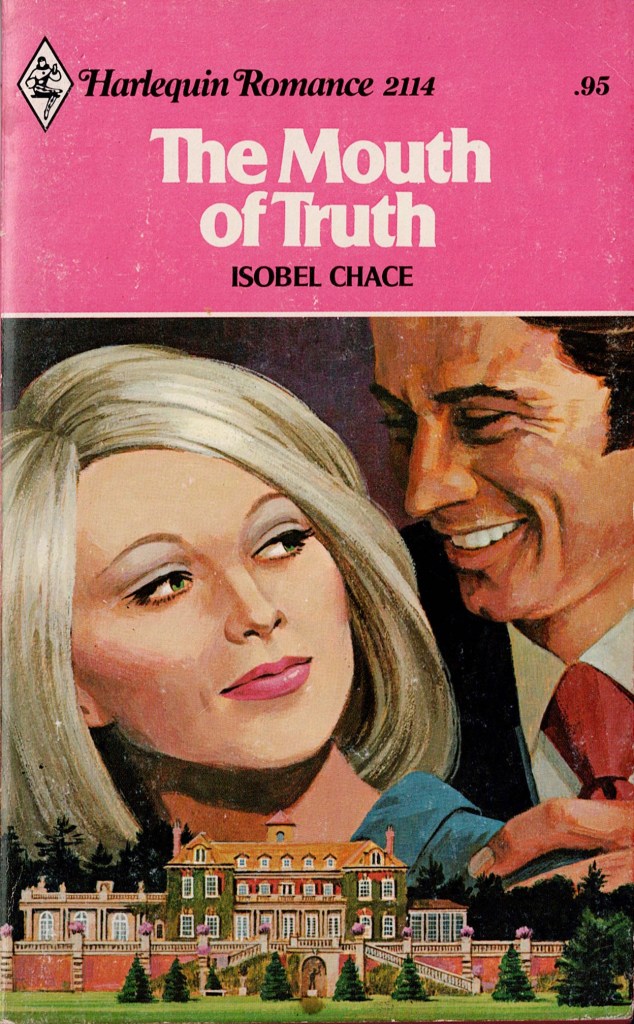
Review – The Mouth of Truth – Isobel Chace (1977)

27 Friday Mar 2026

Posted by Giulia Torre in captiviy, evil other woman, Harlequin Romance, learning to write, rich hero, Romance Cover Art, travel, tropes, vintage romance review

≈ Leave a comment

Tags

1970s harlequin, book-review, book-reviews, books, Boon Harlequin, category romance, cover art, fiction, Harlequin, romance, romance novel reviews, romance writing

Adiamo Roma!!

Alora, quindi, dai…

Required words for the truly Italian.

Also, kidnapping.

Isobel Chace had been writing for awhile by 1977 when this novel was published, with 26 Harlequins before this one.

Diving into the trope trove, Chace came up with captivity for The Mouth of Truth.

As the cover suggests, Domenico Manzù makes his pretty prisoner, Debbie Beaumont, comfortable.

First, with a new wardrobe a Corsa, “Rome’s equivalent to Bond Street.” OMG I can’t wait.

Debbie is an artist. She does a lot of “ultra modern stuff” as a sculptor and painter. She tells Domenico on her maiden limo ride minutes into her captivity: “It takes a while to break out of the chrysalis of needing someone else’s approval.”

Truer words, Debbie…

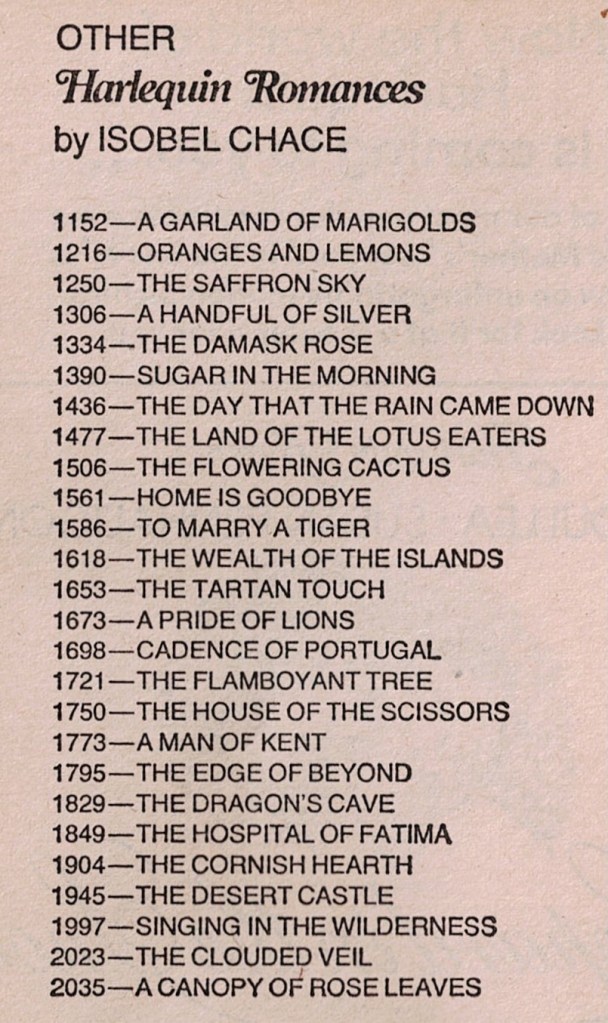
I wanted to read Isobel Chace (1934-2005) because she’s a career romance novelist. Goodreads shows 30 books, but I think there are more.

In spite of the yolk of reader expectation, Chace had likely broken out of her shell by The Mouth of Truth.

Goodreads (House of the Scissors) reports that Chace wrote under the pseudonym of Isobel Chace, and under her real names: Elizabeth Hunter and Elizabeth de Guise. Born in1934 in Nairobi, Kenya, she lived in in Kenya and South Africa, and studied at the Open University.

After 26 books, Chace is mastering the art of “swan lake in a phone booth” to quote romance author phenom and gajillionaire Nora Roberts about the category romance.

The Mouth of Truth had me at hello.

Chace opens with a father-daughter conflict, and with it, I was hooked. Let that be a lesson to you. It wasn’t perfect. It wasn’t terribly well-written. The prose wasn’t memorable, and the characters were a bit obtuse, but I got pulled along in spite of all the imperfections.

It’s all we need, dear author: a little conflict.

Deborah’s Dad is rich, absent (remarried with other kids), but still wants to protect his estranged daughter.

Debbie just wants to go to Rome with her friends. It’s on her own dime. Sure he’s paid her bills in the past! Is he going to begrudge her that now? (Exclamation point alert. Chace spares no spear.)

Deb’s Dad explains that his company had some business dealings in Italy recently and may have inadvertently thrown an election. It’s not ideal for someone sharing his name to visit Italy, not right now.

There’s some foot-stomping, some you-can’t-stop-me, and poof! Debbie is on the plane, staring out the window, wondering if she was right to come.

The plane ride to beyond is a recurring scene in this category line, where the heroines travel just about anywhere…as long as they’re under somebody’s thumb from tarmac through touchdown.

Do you suppose I like being kidnapped?

Thus, the need for this contrived and silly trope.

It’s a hard pill to swallow now, this plot template, but consider the plight of woman in 1977.

The world has shifted beneath the words on these pages, so it’s only fair to take them for what they were worth fifty years ago, recalculating for inflation.

In spite of the fact that this category line resorted to kidnapping, captivity, and a continuum of lock-her-in-a-room scenarios, the machination allowed women to travel the world, essentially on their own.

I’ve said it before, and I’ll say it again, romance is a feminist enterprise.

‘That is one of the advantages of being a man, signorina. My family, like yours, would undoubtedly be far more shocked at your allowing me to kiss you than by my doing so. It’s the way of the world!’
She opened her eyes wide. ‘You mean they’d blame me?’

And gosh, if we compare women’s rights 50 years ago to what we have now, a few elements of 1977 look pretty good.

Anyhoo.

Adesso…Roma!

Enjoy old-school historical romance? Me too! Start with Wolfe Island. It’s available in paperback, ebook, and Audible.

Sign up for more vintage romance reviews. Subscribe to Giulia’s newsletter! I read and write romance and could talk about either, all day long.

Writing a Mind Change

19 Friday Dec 2025

Posted by Giulia Torre in Audible, Giulia Torre, learning to write

≈ Leave a comment

Tags

books, fiction, writing

I returned to the classroom as a student after an absence of twenty years. What I’d loved about being a lit student came back in a rush. The one-credit course that met one hour, once a week was called a slow read – a genre of course design that I can’t recommend more highly.

A slow read is just what it sounds like: an entire fifteen-week semester devoted to one text. In this case, it was Laurence Sterne’s Tristram Shandy.

Ah, Tristram.

This was a book I knew both well and not at all, having tried and failed to read it a few times while pursuing a doctorate in English, another trial which I also failed.

Reading it successfully as a full-time worker and mother-of-two (aka a grown-ass woman), led by a professor who’d taught it many times was, in a word, rapturous.

I wasn’t reading it for anything other than for pleasure…and for what I could learn as a fiction writer.

One teachable moment in Tristram Shandy has stayed with me.

Susannah descends a staircase with a candle.

At the top, she is of one mind.

At the bottom, another.

Poof.

Sterne uses his signature form of slapstick comedy to illustrate the mind’s associative quality, its tendency to hop from one idea to another using segues as stones across a steam. (Locke’s Essay Concerning Human Understanding, made light.)

I found a scene in Great Expectations this week that reminded me that when a character’s mind changes, it needn’t be a game of interiority.

A reader can be shown each infinitesimal shift, held by the hand, paraded past words and actions that demonstrate each small movement of mind.

(For book listeners out there – narrative options exist on Audible for Great Expectations, but Simon Vance is always my top choice.)

In the opening scenes when we’re introduced to the community that surrounds young Pip, he’s cautioned to stay humble. In context, it’s a caution that can be brushed off; he has no expectations, yet.

But then Pip meets Estella.

Dickens is relentlessly repetitive, and (in this case, at least) not just because he was being paid by the word. He uses diction, the simple repetition of choice words, to drive the nail of Pip’s changing self-perception.

Pip’s mind ruminates on Estrella’s complaints: his misuse of “jacks” for “knaves” in playing cards, his “coarse hands” and “thick boots”. He perseverates on the ideas, framed by the same words while still with Estella.

Pip then cries while watched by Estella, triumphant in her dismal efficacy. He stops crying. He starts again when finally alone. Doesn’t cry when taunted a final time, but wants to.

The words are repeated yet again upon reflection on Pip’s walk home, as Dickens reminds his readers that Pip’s change in identity is holding fast.

Pip looks at his coarse hands, his thick boots. He feels shame. He becomes angry at his beloved Joe for teaching him wrongly that knaves were jacks. Pip repeats the same words – coarse hands, thick boots – his new identity markers, again and again.

Poof.

It’s moments like this that, as a writer, stealing and study overlap, and plagiarism becomes homage.

Or formula, if you prefer.

Enjoy old-school historical romance? Me too! Start with Wolfe Island. It’s available in paperback, ebook, and Audible.

Sign up for more vintage romance reviews. Subscribe to Giulia’s newsletter! I read and write romance and could talk about either, all day long.

Giulia Torre on Facebook

Giulia Torre on Facebook

Pages

  • about
  • books
  • contact & subscribe

Archives

  • June 2026
  • May 2026
  • March 2026
  • December 2025
  • September 2025
  • August 2025
  • November 2017
  • October 2017
  • September 2016
  • December 2015
  • October 2015
  • June 2015
  • May 2015
  • February 2015
  • January 2015
  • November 2014
  • October 2014
  • September 2014
  • August 2014

Enter your email address to follow this blog and receive notifications of new posts by email.

Goodreads

Blog at WordPress.com.

  • Subscribe Subscribed
    • GIULIA TORRE
    • Already have a WordPress.com account? Log in now.
    • GIULIA TORRE
    • Subscribe Subscribed
    • Sign up
    • Log in
    • Report this content
    • View site in Reader
    • Manage subscriptions
    • Collapse this bar

Loading Comments...