• about
  • books
  • contact & subscribe

GIULIA TORRE

~ reading and writing romance

GIULIA TORRE

Tag Archives: vintage romance reviews

Review – The Enchanted Trap by Kate Starr (1963)

23 Tuesday Jun 2026

Posted by Giulia Torre in Harlequin Romance, Romance Cover Art, tropes, vintage romance review

≈ Leave a comment

Tags

romance writing, category romance, romance reviews, cover art, Harlequin, Boon Harlequin, 1970s harlequin, romance, romance novel reviews, vintage romance reviews, fiction, books, book-review, book-reviews

Iconic Mills and Boon mid-century trope: Man’s literal job is to destroy the only thing the girl holds most dear, usually a house. Sometimes a hotel or other hospitality institution, like an orphanage. 
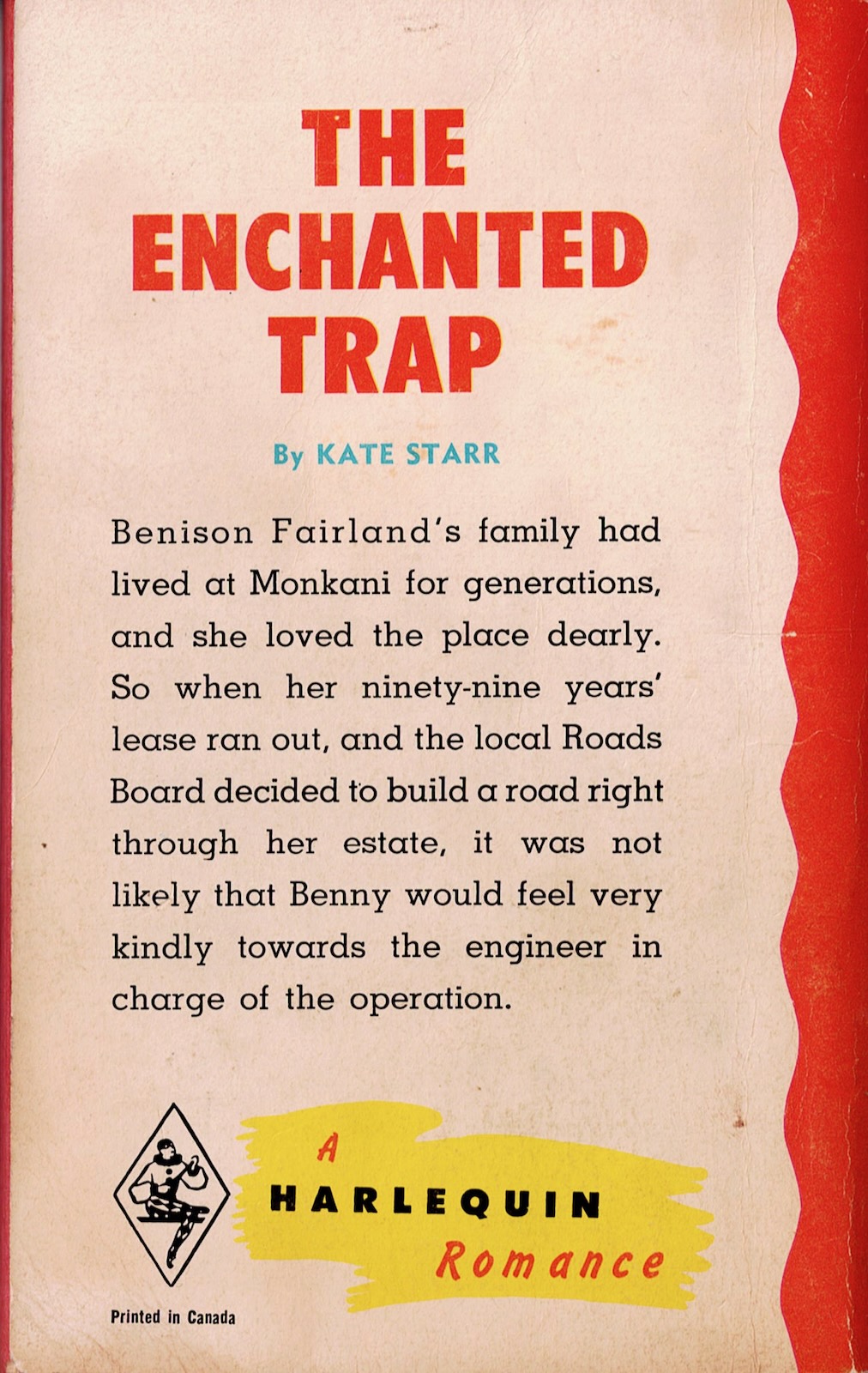
the enchanted trap Harlequin by Kate Starr 1963 edition

In the case of the Enchanted Trap, it’s both – a hotel for children whose parents are going abroad for a month or so. 

 A kennel for children. 

The house is called Monkani and it sits on a parcel of land needed for a road. Why the road has to go right through the house and not around it is unclear. 

Monkani means ‘many thanks’ in the aboriginal language of the Australians who lived there when the house went up 120 years before, when the land was granted to ther heroine’s great-great grandfather by the government in thanks for the discovery of silver. Many thanks!

Kathy Starr’s prose is terribly good.

Listen to this intro.
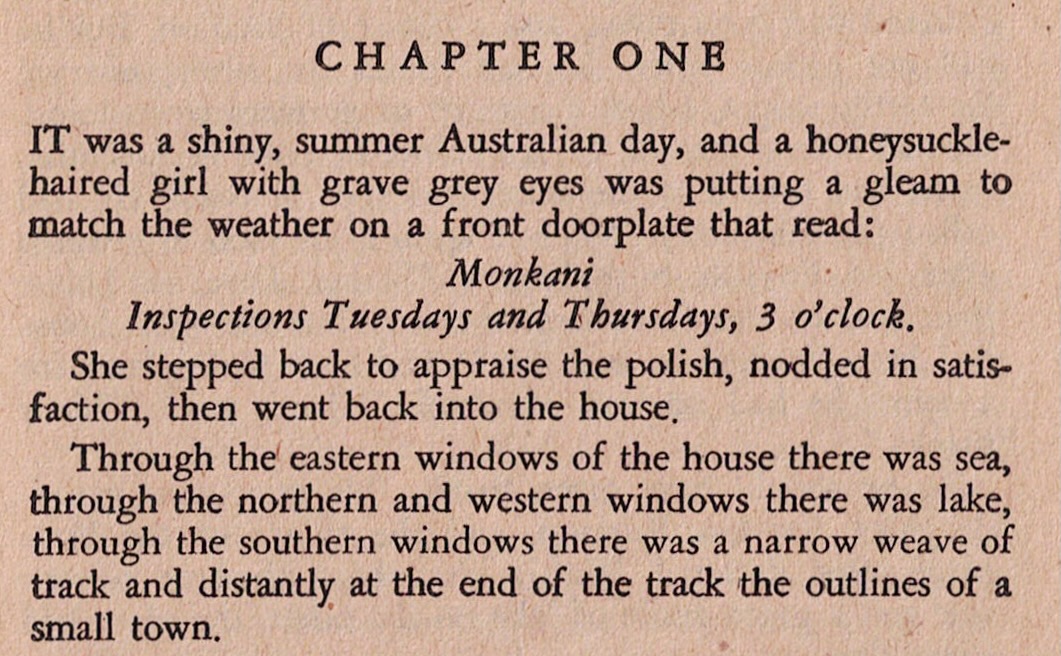
the enchanted trap Harlequin by Kate Starr 1963 edition

But the man is Not Nice.

Yes, he has a way with the children staying at the hotel, so the reader is meant to recognize a tender heart beneath, but he uses his physicality to brow beat and disarrange the heroine. 

I don’t like it when a man squeezes a woman’s shoulder until it hurts to make her do something she doesn’t want to do or picks her up bodily to take her somewhere she doesn’t want to go. Especially in real life, and not in a romance novel. 

But I kept reading because the heroine is strong in more interesting ways than muscle. 

Benison “Benny” Fairland decides to charm Dominic Boyd the road builder and make him believe through repeated bouts of subtle interest cunningly withdrawn that she is submitting to his bulldozer. 

There is very often a moment in these old texts where the author has the hero say something that doesn’t time-travel well, like this:

For a moment you forgot and followed your heart and not your mind…Admit it, now. Admit, too, Benison Fairland, that deep, deep down you’re not really resenting all of this as you’re so obviously trying to. That, like the rest of your sex, you fundamentally prefer to be regulated and controlled.”
This time she could not plan any answer, she simply had to burst out. “You — you—“ she flung, as red in the face as the red handkerchief round the neck of the man in the electric drill. 
“All women like authority,” he said kindly. He lit a cigarette. “Don’t explode,” he advised her. “I like you nice and intact as you are, not disintegrated. I’ve enough disintegration on my road.

A lot to unpack. At least he doesn’t want her ground up. 

This exchange is followed by another moment when he picks her up and for the second time in the book’s first act carries her against her wishes. 

So.

What is the reader supposed to make of Benny’s impotence in the face of Dom’s authority?

Really hard to say.

Am I supposed to feel the feminist in her inarticulate rage? And/or should I find Dom’s appeals to her heartfelt desire to be controlled exciting. At this point in the book, I have no idea. 

Kate Starr, the author has made the heroine impotent in so many ways that I wonder if Benny can only come out on top in the end. Otherwise, what’s her trajectory? Could it be that she starts out a “fish-spinster” resisting the patriarchy, and turns into a submissive guppy?

Alas, it ends with a ritualistic finale for this era’s romance: the heroine wins, but only by getting the chance to destroy the thing she holds most dear by her own hands, a sacrifice for the evidence bag of love. 

And in 1963, no sex. Not even as awesome make out session.

I read it all the way through, but in the end two thumbs down. 

Review – The Little Nobody – Violet Winspear (1972)

15 Monday Jun 2015

Posted by Giulia Torre in Giulia Torre, Harlequin Presents, Harlequin Romance, Hero Archetypes, Romance Cover Art, Uncategorized, vintage romance review, Violet Winspear

≈ 2 Comments

Tags

1970s harlequin, Boon Harlequin, category romance, contemporary romance, cover art, harlequin presents, harlequin romance, Mills and Boon, retro romance, romance novel reviews, vintage romance reviews, Violet Winspear

A Romance Canon, one as staid and firm (and stout) as Harold Bloom‘s should include Violet Winspear, whose corpus includes over 90 titles written for Mills & Boon. I love her name almost as much as I love Foyle’s War’s Honeysuckle Weeks.

The Little Nobody was chosen for the alpha hero lurking beyond it’s title.

Violet Winspear The Little Nobody

With a little nobody, a Big Somebody must be in there somewhere.

Violet Winspear is known for (notorious for at one time) her alpha heroes: angry, incomprehensible heroes and our future bodice rippers. In 1970, she explained:

I get my heroes so that they’re lean and hard muscled and mocking and sardonic and tough and tigerish and single, of course. Oh and they’ve got to be rich and then I make it that they’re only cynical and smooth on the surface. But underneath they’re well, you know, sort of lost and lonely. In need of love but, when roused, capable of breathtaking passion and potency. Most of my heroes, well all of them really, are like that. They frighten but fascinate. They must be the sort of men who are capable of rape: men it’s dangerous to be alone in the room with.

The category line Winspear helped to launched has pervasive arm-gripping, angry kissing, and even spanking. Still, she got a little flack for that.

The Little Nobody is only #15 in the original Harlequin Presents line (of thousands). A more recent Harlequin line of the same name has the same mission as the original:

You want alpha males, decadent glamour and jet-set lifestyles. Step into the sensational, sophisticated world of Harlequin Presents, where sinfully tempting heroes ignite a fierce and wickedly irresistible passion!

The little nobody is Ynis Raiford. She is newly arrived on a dark and stormy night to a gothic castle on the Cornish Cliffs (Cornwall, England) called the Sea Witch.

Her name – Raiford – is not even hers. It’s borrowed from her stepfather, a con man serving time as a result of his designs on the hero’s fortune (a part of it at least). The hero – Gard St. Clair – is a former maestro whose arm was injured by a freak storefront accident, and then severed from his body at the shoulder by a surgeon, unaware he was operating on a famous conductor because Gard’s wallet had been stolen from him by a pickpocket while he was still unconscious and bloody beneath the shattered pane of glass. So, when Ynis’ petty thief stepfather was caught trying to steal from Gard a couple years later, our hero was still a little touchy and unforgiving. Ynis ventures to the Sea Witch to persuade maestro Gard to drop the charges, but finds the hero a tad embittered by pickpockets, his missing arm, and, presumably, the bad weather.

The bad weather is important, because after Gard declines Ynis’ request to free from prison the only family she’s ever known, she runs out into the dark, stormy night and is deservedly hit by a car. She awakes back at the Sea Witch with amnesia and a ring on her finger. Gard claims she’s his fiancé.

Readers of this line are given no insight into the thoughts and feelings of heroes beyond their actions and smoldering looks of incomprehensible rage, but we can assume the hero feels guilty, or something.

So there we have it. Add another woman – “his old love, the beautiful actress Stella Marrick” – and the set-up is a typical 1970s Mills & Boon pretzel-plot.

Of significance…Ynis has been living in a convent for the better part of her life. Though the Reverend Mother tried to convince Ynis to take orders, instead Ynis wants to see the world. She’s at her hills-are-alive moment when this book begins.

What the heroine’s convent background provides is a nice dose of virgin envy. Yes, it’s a real thing. And Winspear knows how to work it.

He didn’t care a rap she found him more fearful than fascinating. He seemed to her to enjoy the fear which she felt. ‘There are certain terrors known only to a girl,’ he said. ‘The fact is fascinating to a man, and that’s the bare truth.’

Virgin envy. I’m green with it.

Giulia Torre on Facebook

Giulia Torre on Facebook

Pages

  • about
  • books
  • contact & subscribe

Archives

  • June 2026
  • May 2026
  • March 2026
  • December 2025
  • September 2025
  • August 2025
  • November 2017
  • October 2017
  • September 2016
  • December 2015
  • October 2015
  • June 2015
  • May 2015
  • February 2015
  • January 2015
  • November 2014
  • October 2014
  • September 2014
  • August 2014

Enter your email address to follow this blog and receive notifications of new posts by email.

Goodreads

Blog at WordPress.com.

  • Subscribe Subscribed
    • GIULIA TORRE
    • Already have a WordPress.com account? Log in now.
    • GIULIA TORRE
    • Subscribe Subscribed
    • Sign up
    • Log in
    • Report this content
    • View site in Reader
    • Manage subscriptions
    • Collapse this bar

Loading Comments...