
• about
  • books
  • contact & subscribe

GIULIA TORRE

~ reading and writing romance

GIULIA TORRE

Tag Archives: romance

Review – The Mouth of Truth – Isobel Chace (1977)

27 Friday Mar 2026

Posted by Giulia Torre in captiviy, evil other woman, Harlequin Romance, learning to write, rich hero, Romance Cover Art, travel, tropes, vintage romance review

≈ Leave a comment

Tags

1970s harlequin, book-review, book-reviews, books, Boon Harlequin, category romance, cover art, fiction, Harlequin, romance, romance novel reviews, romance writing

Adiamo Roma!!

Alora, quindi, dai…
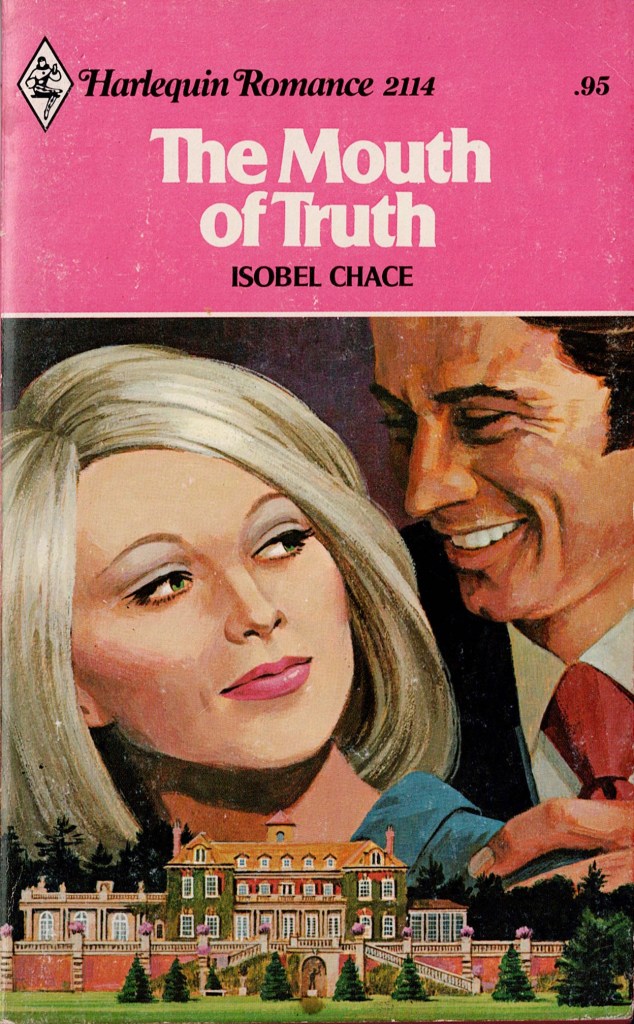
Required words for the truly Italian.

Also, kidnapping.

Isobel Chace had been writing for awhile by 1977 when this novel was published, with 26 Harlequins before this one.

Diving into the trope trove, Chace came up with captivity for The Mouth of Truth.

As the cover suggests, Domenico Manzù makes his pretty prisoner, Debbie Beaumont, comfortable.

First, with a new wardrobe a Corsa, “Rome’s equivalent to Bond Street.” OMG I can’t wait.

Debbie is an artist. She does a lot of “ultra modern stuff” as a sculptor and painter. She tells Domenico on her maiden limo ride minutes into her captivity: “It takes a while to break out of the chrysalis of needing someone else’s approval.”

Truer words, Debbie…

I wanted to read Isobel Chace (1934-2005) because she’s a career romance novelist. Goodreads shows 30 books, but I think there are more.

In spite of the yolk of reader expectation, Chace had likely broken out of her shell by The Mouth of Truth.
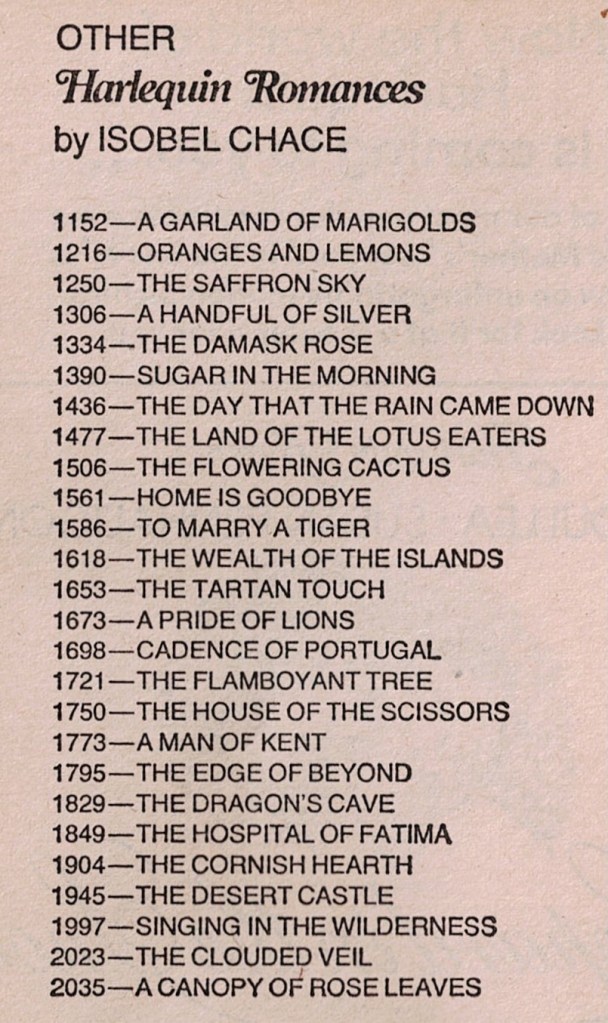
Goodreads (House of the Scissors) reports that Chace wrote under the pseudonym of Isobel Chace, and under her real names: Elizabeth Hunter and Elizabeth de Guise. Born in1934 in Nairobi, Kenya, she lived in in Kenya and South Africa, and studied at the Open University.

After 26 books, Chace is mastering the art of “swan lake in a phone booth” to quote romance author phenom and gajillionaire Nora Roberts about the category romance.

The Mouth of Truth had me at hello.

Chace opens with a father-daughter conflict, and with it, I was hooked. Let that be a lesson to you. It wasn’t perfect. It wasn’t terribly well-written. The prose wasn’t memorable, and the characters were a bit obtuse, but I got pulled along in spite of all the imperfections.

It’s all we need, dear author: a little conflict.

Deborah’s Dad is rich, absent (remarried with other kids), but still wants to protect his estranged daughter.

Debbie just wants to go to Rome with her friends. It’s on her own dime. Sure he’s paid her bills in the past! Is he going to begrudge her that now? (Exclamation point alert. Chace spares no spear.)

Deb’s Dad explains that his company had some business dealings in Italy recently and may have inadvertently thrown an election. It’s not ideal for someone sharing his name to visit Italy, not right now.

There’s some foot-stomping, some you-can’t-stop-me, and poof! Debbie is on the plane, staring out the window, wondering if she was right to come.

The plane ride to beyond is a recurring scene in this category line, where the heroines travel just about anywhere…as long as they’re under somebody’s thumb from tarmac through touchdown.

Do you suppose I like being kidnapped?

Thus, the need for this contrived and silly trope.

It’s a hard pill to swallow now, this plot template, but consider the plight of woman in 1977.

The world has shifted beneath the words on these pages, so it’s only fair to take them for what they were worth fifty years ago, recalculating for inflation.

In spite of the fact that this category line resorted to kidnapping, captivity, and a continuum of lock-her-in-a-room scenarios, the machination allowed women to travel the world, essentially on their own.

I’ve said it before, and I’ll say it again, romance is a feminist enterprise.

‘That is one of the advantages of being a man, signorina. My family, like yours, would undoubtedly be far more shocked at your allowing me to kiss you than by my doing so. It’s the way of the world!’
She opened her eyes wide. ‘You mean they’d blame me?’

And gosh, if we compare women’s rights 50 years ago to what we have now, a few elements of 1977 look pretty good.

Anyhoo.

Adesso…Roma!

Enjoy old-school historical romance? Me too! Start with Wolfe Island. It’s available in paperback, ebook, and Audible.

Sign up for more vintage romance reviews. Subscribe to Giulia’s newsletter! I read and write romance and could talk about either, all day long.
Review – The Everywhere Man – Victoria Gordon (1981)

31 Sunday Dec 2017

Posted by Giulia Torre in feminism, Giulia Torre, Harlequin Romance, vintage romance review

≈ Leave a comment

Tags

category romance, Harlequin, harlequin romance, Mills and Boon, romance, romance novel reviews, romance reviews, sexual harassment

In honor of all the women who in 2017 fundamentally changed the conversation around sexual harassment, in honor of all the women who for a hundred years prior tried and failed, and in honor of those of us to come who will still speak truth to power, even in the face of new ASAP legislation (I speculate here) that will make accusing a white man of anything at all a criminal offense…I give you The Everywhere Man.

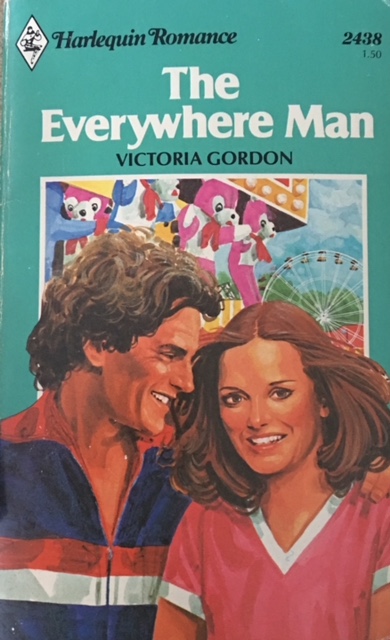
the everywhere man

Because, even if she claims she doesn’t, every woman wants a stalker.

Set in Australia, Alix is an architectural draftswoman with a talent for design and training German Shorthaired Pointers. Alix lost both her parents to a bushfire two years before, a sad fact that serves to motivate our heroine, at the awfully familiar sound of an Australian bushfire, out of the bush onto a busy highway at warp speed. She swerves into a ditch to avoid the hero. In the midst of an angry man rescue, she faints (ffs).

“Obnoxious, arrogant, conceited” Quinn Tennant pulls her out of the ditch. After Alix fails to show proper gratitude, Quinn asks, “Is it part of some Women’s Lib programme to be ungrateful, stroppy, and generally disagreeable?” (p. 17). Expressly claiming payment, he kisses her with “no crude savagery. Only a vast knowing” (p. 18, italics belong to the author). She tries and fails to claw-slap him (“Naughty, naughty” he chides), which is followed by laughter: “Why not relax? You’ve only one more kiss to finish the debt” (p. 19).

The professional rapes described in the story are metaphoric in scope. Victoria Golden, author of Always the Boss (1981) and Age of Consent (1985), among other 80s category romances, is presumably familiar with the issues of sexual predation in and out of the workplace.

Alix’s former fiancee and co-worker, a threadbare stereotype, steals her designs. New hero Quinn Tennant is not only her judge in dog shows, the landlord of her rented cottage, but also her boss. I won’t go into the details of the now-dated professional set-up for the central love scene. It includes a hotel suite, a drink in the boss’ face, a naked roll across the vast bed, an “athletic” dismount from the mattress, followed by a “sprint for the doorway”  (p. 114). Alix’s virtue remains intact because heroines can be out-and-out shrews when confronted with deflowering.

Fast forward through more dog shows to the happily-ever-after: The two are engaged to be married, and Quinn reveals he’s rescued Alix’ stolen designs. She promptly rips the short stack of drawings in half and quarters, saying “these are from the past; they don’t matter now” (p. 189).

What woman would rip up her original drawings? Who would expect her to?

It may mean nothing, but author Victoria Golden is a man, and the a.k.a. was born in response to the publisher’s claim that “no man” could write Harlequin category romance: “Gordon is widely believed to be the first man to seriously meet the challenge.”

I ask myself: is it one thing when readers consume toxic romance narratives imagined by other women, but another thing entirely when they’re crafted by a man (pretending to be a woman)?

My students tell me that it seems sometimes that I love these books, and sometimes that I hate them. Rarely in life am I this conflicted. True, someone can offer me one drink or another, and, faced with a hard choice, I’ll end up with both.

So I’ll end up with both here…

I love romance.

I hate this book.

Enjoy old-school historical romance? Me too! Start with Wolfe Island. It’s available in paperback, ebook, and Audible.

Sign up for more vintage romance reviews. Subscribe to Giulia’s newsletter! I read and write romance and could talk about either, all day long.

Review – Liberated Lady – Sally Wentworth (1979)

04 Saturday Nov 2017

Posted by Giulia Torre in feminism, Giulia Torre, vintage romance review

≈ Leave a comment

Tags

category romance, feminist romance, romance, romance novel reviews, romance reviews


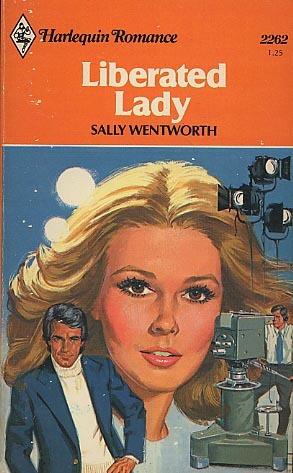
liberated lady wentworth.jpgThis is science folks. And a romance novel from 1979 titled Liberated Lady…? It could be the motherlode. The size of the TV studio camera on the cover screams Lacanian gaze, and Sally Wentworth is celebrated for 101 books on Goodreads. It’s the perfect storm. Talk to me, Goose.
Going in, here are my boy-crazy-yet-feminist (mark my epitaph) hopes for this love story:

  • some consent language, really erotic stuff, that will, you know, teach me to put what I want into words
  • a behind-the-scenes look at a TV studio in 1979
  • really good prose
  • not rape?

I’m not optimistic. First sign of trouble is the inside cover, a total turn on for us rape fetishists who are titillated by forced seduction…

Don’t try to deny what’s between us.

Alex took a purposeful step toward her as Sara raised her hands in a futile attempt to ward him off. But he merely caught her wrists. Briefly she tried to struggle, but he said harshly, ‘It’s too late, the fight’s over.’ And he pulled her into his arms.

His mouth covered hers hungrily, claiming possession, allowing no resistance. Desperately, Sara tried to break free, but she couldn’t escape the passionate torment of his lips, searching, demanding a response.

She made a little sound, deep in her throat an the hand she’d raised to hit him instead sank slowly onto his shoulder and crept around his neck…

That’s right. Just let it go, sisters.

For the entirety of the book he’s mad she won’t admit he turns her on, but then when they can finally agree that she’s totally hot for him, he gives her a job, a part-time PR gig because “she knows something about computers.” Bam. HEA.

*sigh*

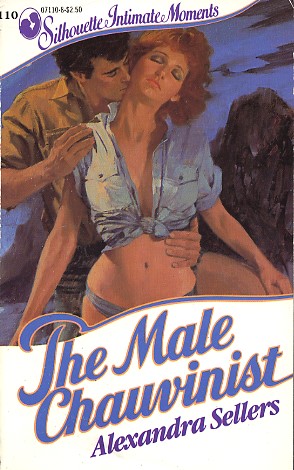
the male chauvanist sellers

I need a hero.

But “sensitive, liberated men” aren’t in the cards for mainstream romantics. Take as another example, Silhouette Intimate Moments (1985) The Male Chauvinist by Alexandra Sellers. First off, I love camp shirts, but is he wearing jorts?

Language is important. Liberation, chauvinism. These things need words, and having them makes talking about the issues easier.

Andreas…seemed to epitomize the attitudes Kate had fought to escape–but his potent sensuality drew her into his arms. No “sensitive, liberated” man had ever had that effect on her.

See how we did that? We found the words to explain that male chauvinists are actually hotter.

Enjoy old-school historical romance? Me too! Start with Wolfe Island. It’s available in paperback, ebook, and Audible.

Sign up for more vintage romance reviews. Subscribe to Giulia’s newsletter! I read and write romance and could talk about either, all day long.

Sex in our Ears – Listening to Romance

10 Friday Oct 2014

Posted by Giulia Torre in Audible, Uncategorized

≈ Leave a comment

Tags

audible, audiobooks, books on tape, orality, readlouds, romance, test of speech

If the medium is the message, what does it mean that for the last several years, more and more readers are listening to books read aloud?

If the narration is good, I will listen to a book multiple times. If the narration is poor, or if the words do not hold up to the test of speech, I do not finish.

Yet not everyone can listen to audiobooks. Quintessential readers in my life cannot. They lose the plot, get distracted. Perhaps for the same reason readers avoid films of their favorite books. They prefer the voices created in their own heads to the ones put there by others.

The more I’ve listened to books, the more I hear my stories as I write them. When these stories are aloud between your ears, does writing becomes something different? Transcription. Dictation.

Writing with the ears. Not world building, or ensuring that, if your characters are outside, that there’s a bird, some rustling leaves, or the sound of a chainsaw. But actually hearing the story in your head as you read. As though so much space exists between your ears that the characters can stand up, walk around, and echo.

Orality. Literacy. Age-old questions. Can you listen?

Giulia Torre on Facebook

Giulia Torre on Facebook

Pages

  • about
  • books
  • contact & subscribe

Archives

  • March 2026
  • December 2025
  • September 2025
  • August 2025
  • August 2024
  • December 2017
  • November 2017
  • October 2017
  • September 2016
  • December 2015
  • October 2015
  • June 2015
  • May 2015
  • February 2015
  • January 2015
  • November 2014
  • October 2014
  • September 2014
  • August 2014

Enter your email address to follow this blog and receive notifications of new posts by email.

Goodreads

Blog at WordPress.com.

  • Subscribe Subscribed
    • GIULIA TORRE
    • Already have a WordPress.com account? Log in now.
    • GIULIA TORRE
    • Subscribe Subscribed
    • Sign up
    • Log in
    • Report this content
    • View site in Reader
    • Manage subscriptions
    • Collapse this bar
 

Loading Comments...