• about
  • books
  • contact & subscribe

GIULIA TORRE

~ reading and writing romance

GIULIA TORRE

Tag Archives: romance novel reviews

Review – The Mouth of Truth – Isobel Chace (1977)

27 Friday Mar 2026

Posted by Giulia Torre in captiviy, evil other woman, Harlequin Romance, learning to write, rich hero, Romance Cover Art, travel, tropes, vintage romance review

≈ Leave a comment

Tags

1970s harlequin, book-review, book-reviews, books, Boon Harlequin, category romance, cover art, fiction, Harlequin, romance, romance novel reviews, romance writing

Adiamo Roma!!

Alora, quindi, dai…
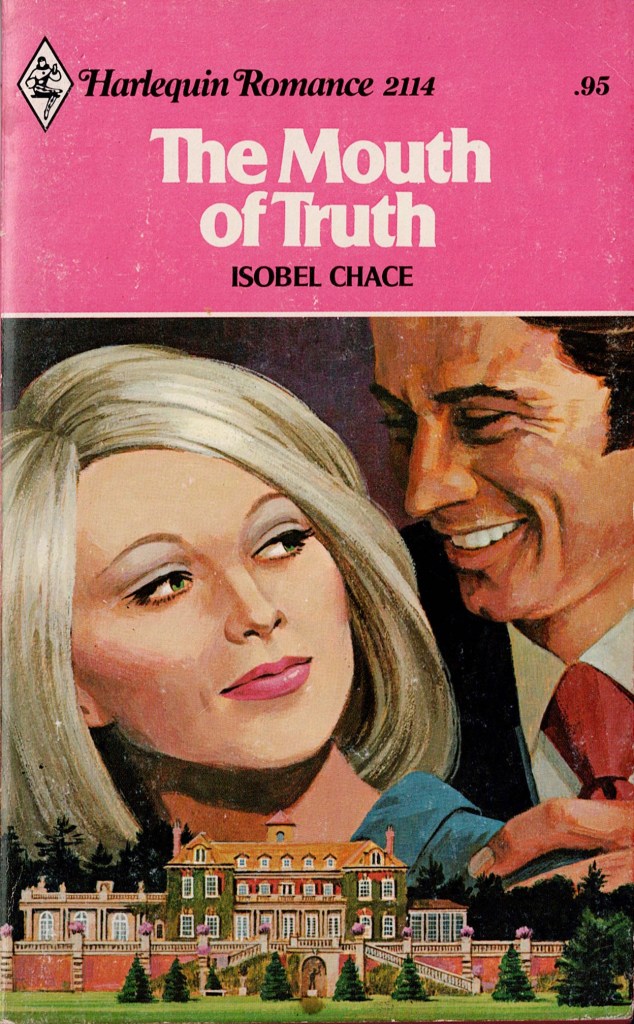
Required words for the truly Italian.

Also, kidnapping.

Isobel Chace had been writing for awhile by 1977 when this novel was published, with 26 Harlequins before this one.

Diving into the trope trove, Chace came up with captivity for The Mouth of Truth.

As the cover suggests, Domenico Manzù makes his pretty prisoner, Debbie Beaumont, comfortable.

First, with a new wardrobe a Corsa, “Rome’s equivalent to Bond Street.” OMG I can’t wait.

Debbie is an artist. She does a lot of “ultra modern stuff” as a sculptor and painter. She tells Domenico on her maiden limo ride minutes into her captivity: “It takes a while to break out of the chrysalis of needing someone else’s approval.”

Truer words, Debbie…

I wanted to read Isobel Chace (1934-2005) because she’s a career romance novelist. Goodreads shows 30 books, but I think there are more.

In spite of the yolk of reader expectation, Chace had likely broken out of her shell by The Mouth of Truth.
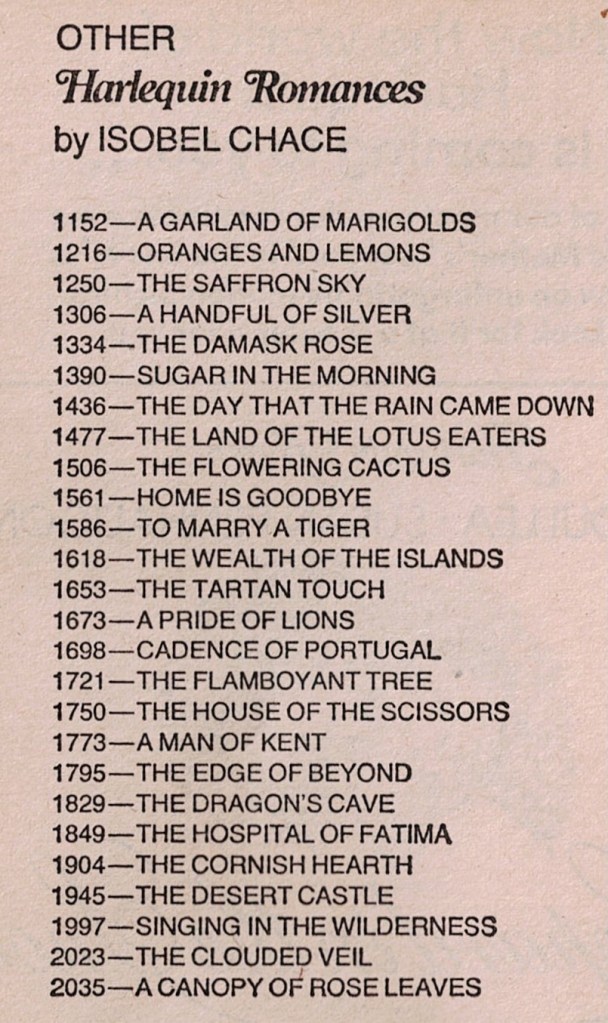
Goodreads (House of the Scissors) reports that Chace wrote under the pseudonym of Isobel Chace, and under her real names: Elizabeth Hunter and Elizabeth de Guise. Born in1934 in Nairobi, Kenya, she lived in in Kenya and South Africa, and studied at the Open University.

After 26 books, Chace is mastering the art of “swan lake in a phone booth” to quote romance author phenom and gajillionaire Nora Roberts about the category romance.

The Mouth of Truth had me at hello.

Chace opens with a father-daughter conflict, and with it, I was hooked. Let that be a lesson to you. It wasn’t perfect. It wasn’t terribly well-written. The prose wasn’t memorable, and the characters were a bit obtuse, but I got pulled along in spite of all the imperfections.

It’s all we need, dear author: a little conflict.

Deborah’s Dad is rich, absent (remarried with other kids), but still wants to protect his estranged daughter.

Debbie just wants to go to Rome with her friends. It’s on her own dime. Sure he’s paid her bills in the past! Is he going to begrudge her that now? (Exclamation point alert. Chace spares no spear.)

Deb’s Dad explains that his company had some business dealings in Italy recently and may have inadvertently thrown an election. It’s not ideal for someone sharing his name to visit Italy, not right now.

There’s some foot-stomping, some you-can’t-stop-me, and poof! Debbie is on the plane, staring out the window, wondering if she was right to come.

The plane ride to beyond is a recurring scene in this category line, where the heroines travel just about anywhere…as long as they’re under somebody’s thumb from tarmac through touchdown.

Do you suppose I like being kidnapped?

Thus, the need for this contrived and silly trope.

It’s a hard pill to swallow now, this plot template, but consider the plight of woman in 1977.

The world has shifted beneath the words on these pages, so it’s only fair to take them for what they were worth fifty years ago, recalculating for inflation.

In spite of the fact that this category line resorted to kidnapping, captivity, and a continuum of lock-her-in-a-room scenarios, the machination allowed women to travel the world, essentially on their own.

I’ve said it before, and I’ll say it again, romance is a feminist enterprise.

‘That is one of the advantages of being a man, signorina. My family, like yours, would undoubtedly be far more shocked at your allowing me to kiss you than by my doing so. It’s the way of the world!’
She opened her eyes wide. ‘You mean they’d blame me?’

And gosh, if we compare women’s rights 50 years ago to what we have now, a few elements of 1977 look pretty good.

Anyhoo.

Adesso…Roma!

Enjoy old-school historical romance? Me too! Start with Wolfe Island. It’s available in paperback, ebook, and Audible.

Sign up for more vintage romance reviews. Subscribe to Giulia’s newsletter! I read and write romance and could talk about either, all day long.
Review – The Everywhere Man – Victoria Gordon (1981)

31 Sunday Dec 2017

Posted by Giulia Torre in feminism, Giulia Torre, Harlequin Romance, vintage romance review

≈ Leave a comment

Tags

category romance, Harlequin, harlequin romance, Mills and Boon, romance, romance novel reviews, romance reviews, sexual harassment

In honor of all the women who in 2017 fundamentally changed the conversation around sexual harassment, in honor of all the women who for a hundred years prior tried and failed, and in honor of those of us to come who will still speak truth to power, even in the face of new ASAP legislation (I speculate here) that will make accusing a white man of anything at all a criminal offense…I give you The Everywhere Man.

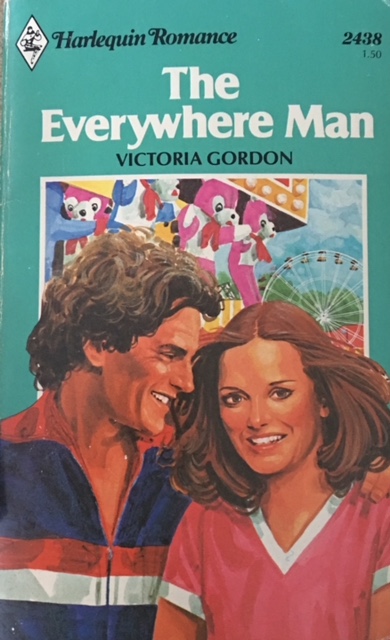
the everywhere man

Because, even if she claims she doesn’t, every woman wants a stalker.

Set in Australia, Alix is an architectural draftswoman with a talent for design and training German Shorthaired Pointers. Alix lost both her parents to a bushfire two years before, a sad fact that serves to motivate our heroine, at the awfully familiar sound of an Australian bushfire, out of the bush onto a busy highway at warp speed. She swerves into a ditch to avoid the hero. In the midst of an angry man rescue, she faints (ffs).

“Obnoxious, arrogant, conceited” Quinn Tennant pulls her out of the ditch. After Alix fails to show proper gratitude, Quinn asks, “Is it part of some Women’s Lib programme to be ungrateful, stroppy, and generally disagreeable?” (p. 17). Expressly claiming payment, he kisses her with “no crude savagery. Only a vast knowing” (p. 18, italics belong to the author). She tries and fails to claw-slap him (“Naughty, naughty” he chides), which is followed by laughter: “Why not relax? You’ve only one more kiss to finish the debt” (p. 19).

The professional rapes described in the story are metaphoric in scope. Victoria Golden, author of Always the Boss (1981) and Age of Consent (1985), among other 80s category romances, is presumably familiar with the issues of sexual predation in and out of the workplace.

Alix’s former fiancee and co-worker, a threadbare stereotype, steals her designs. New hero Quinn Tennant is not only her judge in dog shows, the landlord of her rented cottage, but also her boss. I won’t go into the details of the now-dated professional set-up for the central love scene. It includes a hotel suite, a drink in the boss’ face, a naked roll across the vast bed, an “athletic” dismount from the mattress, followed by a “sprint for the doorway”  (p. 114). Alix’s virtue remains intact because heroines can be out-and-out shrews when confronted with deflowering.

Fast forward through more dog shows to the happily-ever-after: The two are engaged to be married, and Quinn reveals he’s rescued Alix’ stolen designs. She promptly rips the short stack of drawings in half and quarters, saying “these are from the past; they don’t matter now” (p. 189).

What woman would rip up her original drawings? Who would expect her to?

It may mean nothing, but author Victoria Golden is a man, and the a.k.a. was born in response to the publisher’s claim that “no man” could write Harlequin category romance: “Gordon is widely believed to be the first man to seriously meet the challenge.”

I ask myself: is it one thing when readers consume toxic romance narratives imagined by other women, but another thing entirely when they’re crafted by a man (pretending to be a woman)?

My students tell me that it seems sometimes that I love these books, and sometimes that I hate them. Rarely in life am I this conflicted. True, someone can offer me one drink or another, and, faced with a hard choice, I’ll end up with both.

So I’ll end up with both here…

I love romance.

I hate this book.

Enjoy old-school historical romance? Me too! Start with Wolfe Island. It’s available in paperback, ebook, and Audible.

Sign up for more vintage romance reviews. Subscribe to Giulia’s newsletter! I read and write romance and could talk about either, all day long.

Review – Liberated Lady – Sally Wentworth (1979)

04 Saturday Nov 2017

Posted by Giulia Torre in feminism, Giulia Torre, vintage romance review

≈ Leave a comment

Tags

category romance, feminist romance, romance, romance novel reviews, romance reviews


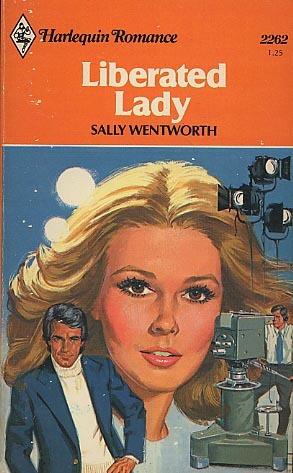
liberated lady wentworth.jpgThis is science folks. And a romance novel from 1979 titled Liberated Lady…? It could be the motherlode. The size of the TV studio camera on the cover screams Lacanian gaze, and Sally Wentworth is celebrated for 101 books on Goodreads. It’s the perfect storm. Talk to me, Goose.
Going in, here are my boy-crazy-yet-feminist (mark my epitaph) hopes for this love story:

  • some consent language, really erotic stuff, that will, you know, teach me to put what I want into words
  • a behind-the-scenes look at a TV studio in 1979
  • really good prose
  • not rape?

I’m not optimistic. First sign of trouble is the inside cover, a total turn on for us rape fetishists who are titillated by forced seduction…

Don’t try to deny what’s between us.

Alex took a purposeful step toward her as Sara raised her hands in a futile attempt to ward him off. But he merely caught her wrists. Briefly she tried to struggle, but he said harshly, ‘It’s too late, the fight’s over.’ And he pulled her into his arms.

His mouth covered hers hungrily, claiming possession, allowing no resistance. Desperately, Sara tried to break free, but she couldn’t escape the passionate torment of his lips, searching, demanding a response.

She made a little sound, deep in her throat an the hand she’d raised to hit him instead sank slowly onto his shoulder and crept around his neck…

That’s right. Just let it go, sisters.

For the entirety of the book he’s mad she won’t admit he turns her on, but then when they can finally agree that she’s totally hot for him, he gives her a job, a part-time PR gig because “she knows something about computers.” Bam. HEA.

*sigh*

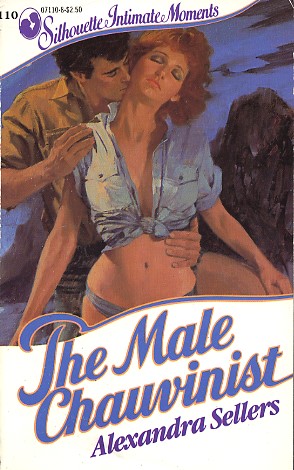
the male chauvanist sellers

I need a hero.

But “sensitive, liberated men” aren’t in the cards for mainstream romantics. Take as another example, Silhouette Intimate Moments (1985) The Male Chauvinist by Alexandra Sellers. First off, I love camp shirts, but is he wearing jorts?

Language is important. Liberation, chauvinism. These things need words, and having them makes talking about the issues easier.

Andreas…seemed to epitomize the attitudes Kate had fought to escape–but his potent sensuality drew her into his arms. No “sensitive, liberated” man had ever had that effect on her.

See how we did that? We found the words to explain that male chauvinists are actually hotter.

Enjoy old-school historical romance? Me too! Start with Wolfe Island. It’s available in paperback, ebook, and Audible.

Sign up for more vintage romance reviews. Subscribe to Giulia’s newsletter! I read and write romance and could talk about either, all day long.

Review – Dear Tyrant – Margaret Malcolm (1953)

30 Monday Oct 2017

Posted by Giulia Torre in Harlequin Romance, vintage romance review

≈ Leave a comment

Tags

category romance, Harlequin, harlequin romance, Mills and Boon, romance novel reviews, romance reviews, romance writing


dear tyant malcolm

First published as Beloved Tyrant in 1953.

Thirty-five Ithaca College undergraduates are taking my first-year seminar Reading Popular Romance. In the footsteps of Carol Thurston and Janet Radway, we leaf through hundreds of roughed-up, red-edged books and mine the texts for what they are: artifacts of popular culture. One collective expression of an unarguably female imagination. The very act of reading is everyday citizen science. We ask ourselves, whatever will these women say next?

Don’t think it matters? Ithaca College’s ivy league neighbor, Cornell University, enrolled hundreds (~) of its undergraduates in a seminar to watch pornography. Students called it “the porn course.” My “trash class” is therefore in good company.

So what have we learned from Dear Tyrant? For one thing, something about a woman’s professional life in the 1950s. Goodreads reports that Margaret Malcolm wrote over 100 romance novels at Mills & Boon from 1940 to 1981. By the time Beloved Tyrant was published in 1953, she’d already written ten.

You’d think after reading hundreds of romance novels that by now the pleasure would be, you know, expected. But it was an unexpected pleasure to see in the pages of Margaret Malcolm‘s Dear Tyrant (1975) reference to Jane Eyre. It’s not unusual for authors of these old category romances to follow Brontë’s lead. Thousands of paperback romances were written before women could be issued credit cards in their own names, while marital rape was legal (legal until 1993 in all 50 states, my friends), when access to the Pill was decades away. One of the few jobs available to Harlequin’s heroines – or for women in general for that matter – was as a caretaker for homebound invalids or children. It shouldn’t have moved me overmuch when the character sees her own reflection in governess Jane Eyre. Still, I was tickled.

Because even in her eleventh book, Margaret Malcolm was having fun. Not only does her heroine laugh at the image of herself as Jane Eyre, but she also attends a masquerade ball, has to leave by the stroke of midnight, and loses a shoe in the throes of her speedy departure. A nod to Jane Eyre, and a wink at Cinderella.

Eleven books in, with eighty-nine to go? That’s about time a career romance writer taps her nose and says I got this, too.

Enjoy old-school historical romance? Me too! Start with Wolfe Island. It’s available in paperback, ebook, and Audible.

Sign up for more vintage romance reviews. Subscribe to Giulia’s newsletter! I read and write romance and could talk about either, all day long.


Review – Blue Jasmine – Violet Winspear (1969)

29 Thursday Sep 2016

Posted by Giulia Torre in Harlequin Romance, Hero Archetypes, Romance Cover Art, Uncategorized, vintage romance review, Violet Winspear

≈ 1 Comment

Tags

Blue Jasmine, Boon Harlequin, category romance, rape in romance, romance novel reviews, romance reviews, romance writing, The Sheik, vintage romance, Violet Winspear

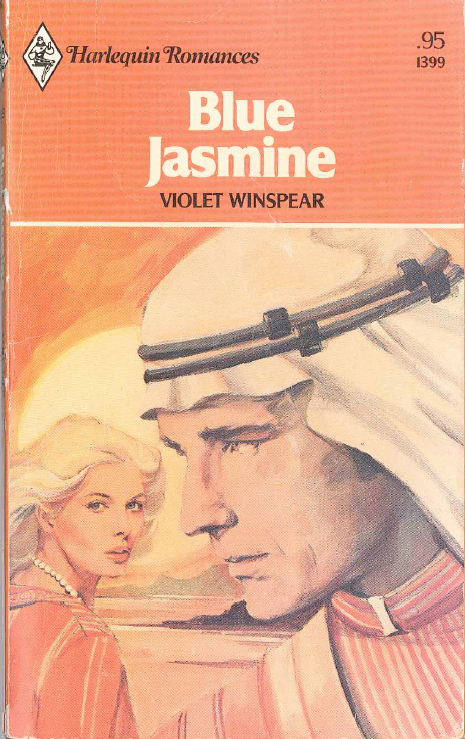
Originally published in hardcover in 1969 by Mills & Boon, Violet Winspear’s category line classic Blue Jasmine, had three Harlequin Romance line reprints by 1976. If there was to be a romance canon, Blue Jasmine might make the list.

But it’s impossible to review Blue Jasmine without the foundation of E. M. Hull’s The Sheik. It’s like trying to discuss Samuel Johnson without mentioning James Boswell. And really, why would you want to?

Blue Jasmine Violet WinspearE(dith) M(aude) Hull’s (1919) The Sheik is, in fact, an even surer ringer for the romance canon (again, if such a thing existed). The Sheik’s Ahmed Ben Hassan was played by Rudolph Valentino in a 1921 film adaptation to audiences who just couldn’t believe it. As a romance subgenre, it’s a long-time market win.

The two novels are similar enough in storyline and character development that I’ve had students argue Blue Jasmine is plagiarized. I say instead that Blue Jasmine is a worthy tribute that imitates to flatter.

Take as a goose-pimpling example the scene when the heroine realizes she’s trapped in a tent with the sheik, surrounded by his loyal entourage in the middle of the desert, and there’s no escape from his animal spirits…

In The Sheik by EM Hull:

Why have you brought me here?” she asked, fighting down the fear that was growing more terrible every moment.

He repeated her words with a slow smile. “Why have I brought you here?” Bon Dieu! Are you not woman enough to know?

And in Blue Jasmine by Violet Winspear:

I have no need of your money, so I fear it cannot buy your freedom. There is only one thing that can, and you are a surpassing innocent if you don’t know what it is.”

She stared at him, her eyes like bruised flowers in her pale, shocked face. “I don’t know,” she whispered.

“Really?” His eyes flicked over her. “With your unusual looks, you tell me you don’t know what a man means when he brings you to his tent. Ma belle femme, I think you do know.

the sheik EM HullBoth The Sheik and Blue Jasmine present typical Winspear heroes. If you remember, Winspear presents heroes who “frighten but fascinate…the sort of men who are capable of rape: men it’s dangerous to be alone in the room with.” Winspear, however, likely wouldn’t have loved Ben Hassan. Sadly, Diana, the heroine of The Sheik, is raped off-scene, repeatedly, and for several months (until she falls in love, as any woman would).

Although Blue Jasmine‘s sheik, Kasim ben Hussayn is a  Mr. Angrypants of the first order, heroine Lorna is yet spared rape. A Winspearean hero, a product of his time, would threaten, but never follow through (unless he was a captain of a sailing vessel).

Blue Jasmine first cover

original 1969 cover of Blue Jasmine

As for the heroines, Blue Jasmine‘s Lorna is independent, saucy, up for adventure. Diana in The Shiek is presented as all these things, but, in addition: boyish and unfeeling, an interesting corruption of womanhood that in the first quarter of the twentieth century might demand correction more so than by the late 1960s. But, of course, both heroines fall for their captors, succumbing (in similarly described pivotal scenes) on a far side of the enemies-to-lovers trope continuum.

After all is said and done, Winspear’s heroine, like Hull’s, is revealed (thank the Almighty Christian God) to have fallen for a European. Today’s popular romance market might not balk with singular voice at a bona fide Arab hero (and all of our gods please bless this guy), but in 1919 and 1969, a sheik had to look like a Princeton man.

Enjoy old-school historical romance? Me too! Start with Wolfe Island. It’s available in paperback, ebook, and Audible.

Sign up for more vintage romance reviews. Subscribe to Giulia’s newsletter! I read and write romance and could talk about either, all day long.


Review – Arctic Enemy – Linda Harrel (1981)

01 Thursday Oct 2015

Posted by Giulia Torre in Uncategorized

≈ Leave a comment

Tags

1970s harlequin, 1980s harlequin, Boon Harlequin, category romance, contemporary romance, cover art, Mills and Boon, romance novel reviews, romance reviews, romance writing

Arctic EnemyArctic Enemy Harrel romance cover art by Linda Harrel (1981) puts journalist Sarah Grey on supertanker Arctic Enterprise during its the maiden voyage through the Northwest Passage, and earns my esteem by spelling ‘grey’ the right way.

The trip is perilous indeed. The Enterprise is designed to load up on liquid gas then nose its way through the ice of the ocean with its highly combustible cargo. Unfortunately, the book’s anti-hero has built the Enterprise with substandard materials, something breaks in the middle of the ocean, and our true hero – Captain Guy Court – must save the day. Which he does. But not before he and Sarah snowmobile out into the arctic countryside, get caught in a storm, and almost make love in an igloo.

It’s a standard hate-at-first-sight / he-thinks-she’s-sleeping-with-the-bad-guy plot line, seasoned with interesting arctic trivia. Did you know that icebergs “calf”?

But enough about global warming.

I’m developing book three of my Diamonds on the Water series, titled The Hard Dock. Yes, I’m really going to title a historical romance that I actually hope to sell The Hard Dock. Because docking can be hard, as anyone who’s ever tried it knows.

The Hard Dock‘s hero – Michael Low – is captain of a tugboat. The heroine – Dorrie Tremont – is a stowaway who gets herself into more trouble than Mick can manage alone. Together, they make a great team. In spite of his angry-man reserve and her counter-phobic pluck.

An actual hard dock is my preferred corner of the Thousand Island Region of Upstate NY, where this series is set in 1893. It’s a concrete dock in a busy spot of the river channel, from where I can swim, watch large freighters pass, and spy on hard-bodied youth as they hurl themselves, heads foaming with shampoo, from the adjacent wooden pavilion dock. The hard dock is less populated, more to my liking.

The point of this summer-nostalgic mawk is that I selected Arctic Enemy because I thought it would be valuable research for The Hard Dock.

Anyone who’s ever written a romance knows there’s no better introduction to scientific and historical fact than another romance author.

Alas, the sexiest moment in Arctic Enemy is when Harrel somehow channels Jean-Luc Picard six years before Next Generation launches its version of the Enterprise.

‘Come!’

I wish.

Enjoy old-school historical romance? Me too! Start with Wolfe Island. It’s available in paperback, ebook, and Audible.

Sign up for more vintage romance reviews. Subscribe to Giulia’s newsletter! I read and write romance and could talk about either, all day long.

Review – The Little Nobody – Violet Winspear (1972)

15 Monday Jun 2015

Posted by Giulia Torre in Giulia Torre, Harlequin Presents, Harlequin Romance, Hero Archetypes, Romance Cover Art, Uncategorized, vintage romance review, Violet Winspear

≈ 2 Comments

Tags

1970s harlequin, Boon Harlequin, category romance, contemporary romance, cover art, harlequin presents, harlequin romance, Mills and Boon, retro romance, romance novel reviews, vintage romance reviews, Violet Winspear

A Romance Canon, one as staid and firm (and stout) as Harold Bloom‘s should include Violet Winspear, whose corpus includes over 90 titles written for Mills & Boon. I love her name almost as much as I love Foyle’s War’s Honeysuckle Weeks.

The Little Nobody was chosen for the alpha hero lurking beyond it’s title.

Violet Winspear The Little Nobody

With a little nobody, a Big Somebody must be in there somewhere.

Violet Winspear is known for (notorious for at one time) her alpha heroes: angry, incomprehensible heroes and our future bodice rippers. In 1970, she explained:

I get my heroes so that they’re lean and hard muscled and mocking and sardonic and tough and tigerish and single, of course. Oh and they’ve got to be rich and then I make it that they’re only cynical and smooth on the surface. But underneath they’re well, you know, sort of lost and lonely. In need of love but, when roused, capable of breathtaking passion and potency. Most of my heroes, well all of them really, are like that. They frighten but fascinate. They must be the sort of men who are capable of rape: men it’s dangerous to be alone in the room with.

The category line Winspear helped to launched has pervasive arm-gripping, angry kissing, and even spanking. Still, she got a little flack for that.

The Little Nobody is only #15 in the original Harlequin Presents line (of thousands). A more recent Harlequin line of the same name has the same mission as the original:

You want alpha males, decadent glamour and jet-set lifestyles. Step into the sensational, sophisticated world of Harlequin Presents, where sinfully tempting heroes ignite a fierce and wickedly irresistible passion!

The little nobody is Ynis Raiford. She is newly arrived on a dark and stormy night to a gothic castle on the Cornish Cliffs (Cornwall, England) called the Sea Witch.

Her name – Raiford – is not even hers. It’s borrowed from her stepfather, a con man serving time as a result of his designs on the hero’s fortune (a part of it at least). The hero – Gard St. Clair – is a former maestro whose arm was injured by a freak storefront accident, and then severed from his body at the shoulder by a surgeon, unaware he was operating on a famous conductor because Gard’s wallet had been stolen from him by a pickpocket while he was still unconscious and bloody beneath the shattered pane of glass. So, when Ynis’ petty thief stepfather was caught trying to steal from Gard a couple years later, our hero was still a little touchy and unforgiving. Ynis ventures to the Sea Witch to persuade maestro Gard to drop the charges, but finds the hero a tad embittered by pickpockets, his missing arm, and, presumably, the bad weather.

The bad weather is important, because after Gard declines Ynis’ request to free from prison the only family she’s ever known, she runs out into the dark, stormy night and is deservedly hit by a car. She awakes back at the Sea Witch with amnesia and a ring on her finger. Gard claims she’s his fiancé.

Readers of this line are given no insight into the thoughts and feelings of heroes beyond their actions and smoldering looks of incomprehensible rage, but we can assume the hero feels guilty, or something.

So there we have it. Add another woman – “his old love, the beautiful actress Stella Marrick” – and the set-up is a typical 1970s Mills & Boon pretzel-plot.

Of significance…Ynis has been living in a convent for the better part of her life. Though the Reverend Mother tried to convince Ynis to take orders, instead Ynis wants to see the world. She’s at her hills-are-alive moment when this book begins.

What the heroine’s convent background provides is a nice dose of virgin envy. Yes, it’s a real thing. And Winspear knows how to work it.

He didn’t care a rap she found him more fearful than fascinating. He seemed to her to enjoy the fear which she felt. ‘There are certain terrors known only to a girl,’ he said. ‘The fact is fascinating to a man, and that’s the bare truth.’

Virgin envy. I’m green with it.

REVIEW – Kiss of a Tyrant – Margaret Pargeter (1980)

29 Wednesday Oct 2014

Posted by Giulia Torre in Harlequin Romance, Hero Archetypes, Romance Cover Art

≈ 1 Comment

Tags

1970s harlequin, 1980s harlequin, 1980s romance, best romance novels, Boon Harlequin, category romance, contemporary romance, cover art, giulia torre, Harlequin, hero, hero archetype, retro romance, retro romance novels, romance book review, romance cover art, romance novel cover art, romance novel reviews, romance reviews, romance writing, romantic hero, vintage romance

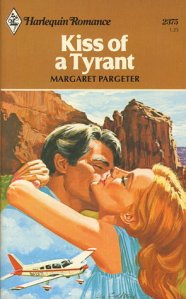
Kiss of a Tyrant PargeterKiss of a Tyrant by Margaret Pargeter
Harlequin Romance #2375

The virgin’s vindication. One of my favorite tropes. If you don’t know of it yet, it’s a good one. It culminates with the hero – an angry man of the highest order – as his head snaps up to look in mute horror to study the face of the maiden beneath him after he’s inadvertently stolen her virginity. The inadvertent part is important.

But not as important as the hero’s grim belief that the heroine is not a virgin. And dammit, she should be.

What if I asked you to prove you’d never belonged to another man?

Such is the way with Kiss of a Tyrant.

Sloan Maddison is an Australian alpha male who finds himself in the English countryside where his widowed mother contemplates returning to live. In a country inn, he meets interior decorator Stacy Weldon. Stacy is “on leave” from her career, helping her mother and sister at the inn after being nearly raped by her boss. She is wounded and angry and not optimistic about her future.

Sloan is attracted to her. Pretty sure he wants to marry her. So uses his mother’s illness as an excuse to carry her off to Australia. But on the way out the door, he gets wind of that “affair” with her boss. And he’s hopping mad about it. She must have asked for it, and along the way, collected other affairs that now debases their own kindling desire.

The hero’s she-must-have-asked-for-it motivation is a hole in the plot that has widened over time. But it’s easy to jump across. Because Sloan is sexy in the way only an angry pants hero can be. Mean, misguided, and hard to get. Oh, but in love nonetheless.

The wrap-up is a bit holey, too, and would have been for readers even in 1980. Sloan is mean to Stacy up until the final moment, but claims he had known of her innocence for the preceding two whole days before the final page. He wanted to see if she could really adapt to his remote Australian way of life. Huh.

Sloan is mean as a billy goat. But, alas, sexier. So I can forgive the holes, even if Mr. Angrypants can’t.

REVIEW – The Angry Man by Joyce Dingwell (1979)

22 Wednesday Oct 2014

Posted by Giulia Torre in Harlequin Romance, Hero Archetypes, Romance Cover Art

≈ 1 Comment

Tags

1970s harlequin, Boon Harlequin, category romance, contemporary romance, cover art, giulia torre, Harlequin, hero, hero archetype, retro romance, romance book review, romance cover art, romance novel cover art, romance novel reviews, romance reviews, romance writing, romantic hero, vintage romance, wolfe island

The Angry Man Joyce DingwellThe Angry Man by Joyce Dingwell (1979) Harlequin Romance #2318 The Angry Man. How could I not?

First, a detour to cover art. I am working with an artist on the cover of book two of the RiverLust series, Simon’s Story. It’s called Swan Bay. I don’t believe you can paint a handsome man on the cover of a romance novel. Beautiful heroines? Yes. But the heroes always come off wrong.

Point in fact: The Angry Man cover hero is bleak. Crocodile Dundee with a longer face and shadowed, sunken cheeks. His hair is some kind of a poofy gray 70s mullet. Go ahead. Take a look at the cover of The Angry Man. Does he look angry to you? See that slight lift of his upper lip, over there on the right? The way his brows are furrowed together as he regards the heroine? Yes. The lovely doe-eyed one.

He is not angry; he’s sardonic, bemused. The man on this cover looks more perturbed than angry. Which is the perfect summation of Joyce Dingwell’s hero in this book.

English Polly loved her neighbor, who loved her sister, so her uncle sent her away. To Australia. Where after working on a statistics team as the resident non-statisician, she is told she has to stay another six months, because her former lover’s courtship of her sister is going more slowly than anticipated. So she takes the position of paid companion to Mrs. Clemance, young and beautiful wife of Thorn Clemance. Thorn is an ag specialist for a pharmaceutical company. A medical herbalist. But the beautiful Mrs. Clemance is not his wife. It’s his cousin’s widow. The hero is, in fact, not married. We learn this as the heroine does, and it’s a breathless beat.

Look at me, MissKendall, look at me, tell me what you see.’ ‘I-I don’t understand you.’ Polly tried to retreat a step, but he advanced, and at once they stood barely an inch apart. I think you do understand. I think you see a man who is a no-half-measures man. I think you see a man who would not be put off with subtleties, evasions and half-truths from any woman he made his wife. I think you see a man who would demand an entirety, a fulfillment, a conclusion, a completion.’ A pause. ‘I think you see a man who would be demanding four, not eight walls.”

Oh, dear. Here’s looking at you.

The ultimate logic of conflict? Unknown.

There is an ancestral puzzle requiring a flow chart to comprehend. And, for some reason, Thorn couldn’t tell Polly about his cousin’s widow’s recent sanitarium visit, her convalescence in his home, or the will that required that before she inherit, she must remain unmarried for two years. Which would have explained Polly’s charge to keep the young woman away from men.

The hero is in fact exactly like his picture (and the reader). Confused and frustrated. Not an awful book. Joyce Dingwell (b. 1908) wrote 80 of them. She knew how to write.

But for this one, in the end, I am left with only a single, bright nugget: Upon first introduction, her toes were dipped in the river until he found her and hauled her out. A shark had taken the hero’s dog from that very rock, only a week earlier.

There is no cure for a shark attack…When you put your gear on we’ll get back.’ ‘Gear? I’ve only removed my shoes and my pantyhose!’ He shrugged, saying almost uninterestingly: ‘Put ‘em on.’ Incensed, feeling a fool, hoping at least he would look away as she did so, Polly complied. It was not easy to wriggle discreetly into pantyhose, and she wished he would wander off. A tactful man would have. But he didn’t, he stood there right to the final hitch.

The final hitch? This whole line of books is worth reading for the settings. These girls get to go everywhere.

REVIEW – The Travelling Kind – Janet Dailey

15 Wednesday Oct 2014

Posted by Giulia Torre in Uncategorized

≈ Leave a comment

Tags

#sexysentences, 1970s harlequin, 1980s harlequin, 1980s romance, category romance, contemporary romance, cowboy romance, Harlequin, harlequin presents, Janet Dailey, romance novel reviews, vintage romance

TThe Travelling Kind Janet Daileyhe Travelling Kind – Janet Dailey (1981)
Harlequin Presents #427

She noticed his kit before she noticed him. A firm leather saddle, smooth from riding. A promising start indeed. I’m a new country gal, and I love me a cowboy.

Charley Collins works an Idaho ranch with her brother, who has just broken his leg, so she needs a hired hand. She gets in her old truck and drives around looking for one.

She finds Shad.

No. No comment.

Shad Russell is a drifter. As the teaser promises, “Falling in love with a man like Shad would be asking for heartache.” He’s a loner, never settling in one place for long.

In the mean time, she hires him and he sleeps in the bedroom across the hall.

I’d never read a Janet Dailey book before. She wrote a romance for every state in the union. I’m embarrassed to admit that in 1981, I don’t know how many books that means, but somewhere close to 50. In the year The Travelling Kind was published, Harlequin saluted her as “the world’s No. 1 publisher of romance fiction!”

A little taste of the no-good-for-Charley drifter…

His mouth came down those last few inches to settle onto her lips with tantalizing ease. A sweet rush of forbidden joy ran through her veins as her hands slid around his neck and she melted into his arms. A steel band circled her waist to press her tighter to his length while his other hand tunneled under the thickness of her hair to cup the back of her head. The driving hunger of his kiss parted her lips, giving him access to the most intimate recesses of her mouth. She was caught in a whirl of sensation, all golden and consuming.

Although a stew of familiar now, this is a pretty great kiss for 1981. But with this book comes a few cock-blocks. Namely, the neighboring rancher, Chuck, who wants to marry her. Yeah, Chuck and Charley. Chuck is neither smart nor sexy. When Shad finally does leave, after Charley’s humiliating sobs (humiliating for Charley and the reader) and shouting at Shad that she won’t wait for him, she doesn’t. And she gets engaged to Chuck.

Until Shad returns two months later, the night of the engagement party. “I know I hurt you when I left but – Aren’t you glad to see me?” Banal cowboys must not be my thing. Because when he walks away, and Charley returns the ring to Chuck, I just want Shad to keep on drifting.

← Older posts

Giulia Torre on Facebook

Giulia Torre on Facebook

Pages

  • about
  • books
  • contact & subscribe

Archives

  • March 2026
  • December 2025
  • September 2025
  • August 2025
  • August 2024
  • December 2017
  • November 2017
  • October 2017
  • September 2016
  • December 2015
  • October 2015
  • June 2015
  • May 2015
  • February 2015
  • January 2015
  • November 2014
  • October 2014
  • September 2014
  • August 2014

Enter your email address to follow this blog and receive notifications of new posts by email.

Goodreads

Blog at WordPress.com.

  • Subscribe Subscribed
    • GIULIA TORRE
    • Already have a WordPress.com account? Log in now.
    • GIULIA TORRE
    • Subscribe Subscribed
    • Sign up
    • Log in
    • Report this content
    • View site in Reader
    • Manage subscriptions
    • Collapse this bar
 

Loading Comments...